

“Which is better, the FuelBand or the Up?” “What do you think about the Fitbit Flex?”
I’ve been hearing questions like these a lot lately. Wearable “activity trackers” — not long ago a niche product — are gaining popularity, and people are curious about how they function and whether they are worth the investment.
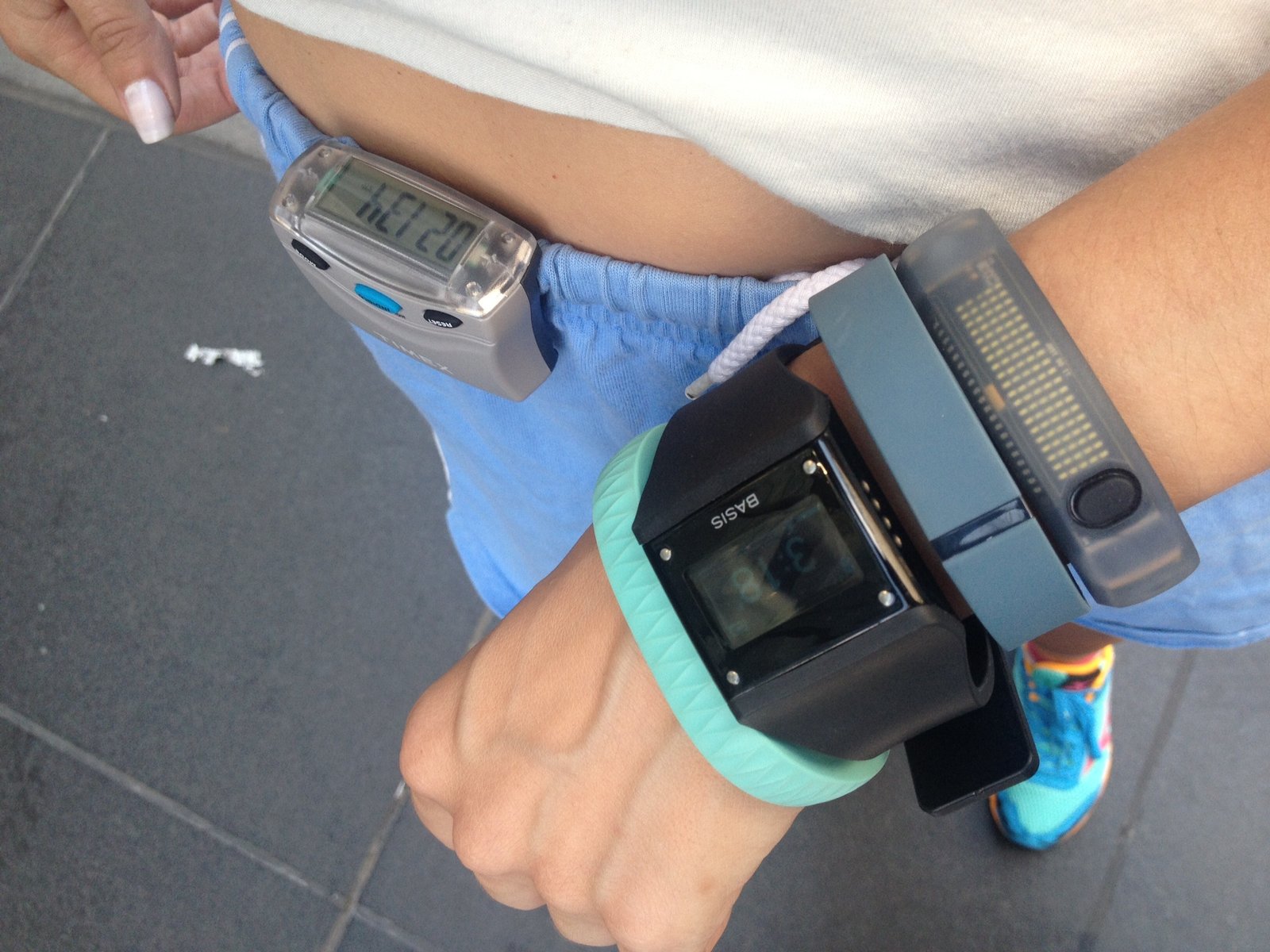
I decided to wear a variety of trackers simultaneously for 10 days to get a true sense of their features and, more importantly, their accuracy.
The four I tested — the Jawbone Up, the Nike+ FuelBand, the Fitbit Flex, and the Basis Band — all perform the same core function: They are worn on the wrist, utilize accelerometers to track steps and activity levels throughout the day, and transmit that data to a mobile app. Beyond that, their feature sets differ.
So, which band is best for you, and which is the most accurate? Read on.
Design-wise, my top pick is the Jawbone Up. It is aesthetically pleasing and wraps around the wrist like a coil bracelet, requiring no clasp or snap. The Fitbit Flex provides the Up with some stiff — or rather, flexible — competition. It is also crafted from a soft, comfortable elastomer, though the band must be clasped on the underside of the wrist.
The Basis Band is a watch, not a band. It definitely looks more like a gadget than a fashion accessory, but it is relatively lightweight. The Nike+ FuelBand is chunky and rigid, and every time I snap it shut on my wrist, I worry I might pinch my skin.
Beyond comfort, there is another factor to consider: displays. Both the Nike+ FuelBand and the Basis Band show you the time, step count, and calories burned directly on the device. Over time, I grew to appreciate being able to view this data without having to pull out my phone and sync the bands, as is required with the others.
Most of these devices use Bluetooth to wirelessly sync activity data to your phone. The Up is the only one that requires you to plug the band into your phone, which was strangely satisfying to do once or twice a day to check my progress. However, the Fitbit Flex’s incredibly fast wireless syncing really impressed me.
I don’t want to overlook the mobile apps, as I believe the compatible software is a significant part of the activity-tracking experience. These apps allow users to log food intake or link to other services, such as RunKeeper, to get a more comprehensive view of their daily habits. However, accuracy is a primary focus of this column, and I want to address that.
I will say this about the apps: I have 17 friends using the Up, nine on Fitbit, zero on Basis, and a few on the Nike+ FuelBand app (though I know for a fact that more of my friends use Nike+; we just aren’t connected through the platform). I’ve found that having more friends wearing the same device greatly enhances the overall experience.
Also, in my first column about the Nike+ FuelBand, I wrote that Nike “Fuel” — the company’s proprietary currency for measuring exertion levels using an algorithm based on oxygen kinetics — felt somewhat arbitrary. After giving the FuelBand and its app a second try, I still feel that way.
When it comes to accuracy, your hips don’t lie.
It is widely acknowledged, even by the creators of these devices, that a standard hip pedometer will provide a more accurate step count than a wrist-worn tracker. Wristbands can register “false positives”; for example, you could be sitting at your desk, but if you wave your arms, the band might record it as activity. Conversely, you could be walking briskly while pushing a stroller without pumping your arms, which could affect the reading.
All of the companies have designed their bands with these factors in mind. However, I wanted to test them myself.
I wore a Timex hip pedometer ($30) while wearing all four bands on my wrist. I was completely decked out and utterly dorktastic. I mapped out a mile in my neighborhood using Google Maps, RunKeeper data, and the pedometer’s mileage gauge. I performed this walk almost every day for a week, comparing each band’s calculations at the start and finish of the mile.
For short-term activity tracking, the Jawbone Up and Fitbit Flex tended to be the most accurate. The Nike+ FuelBand and Basis Band were more consistently conservative, and the Basis Band occasionally provided very low readings.
Here is a sample day, with the pedometer registering 2,165 steps at one mile: The Up measured 2,166 steps, the Basis Band 2,157 steps, the Flex 2,140 steps, and the Nike+ FuelBand 2,076 steps.
But on another test day, when I walked slightly over a mile, the pedometer registered 2,382 steps, the Up measured 2,339, the Flex 2,290, the FuelBand 2,103, and the Basis Band a bizarre 1,614.
I also conducted a few full-day tests, during which I was mostly working at my desk but also walked around the neighborhood, and found that all four bands registered more steps than the basic hip pedometer. In one such test, the pedometer registered 7,428 steps, while the Basis Band tracked 7,736 steps, the FuelBand measured 7,905 steps, the Up 8,369 steps, and the Fitbit Flex 8,400 steps.
That is a lot of false positives if you trust the hip pedometer. The Up and the Flex can be calibrated for better accuracy — you essentially “tell” the band you have walked an exact distance and it adjusts your steps accordingly — but I didn’t notice a massive difference after doing so.
One element of these bands I am skeptical of is the sleep-tracking function. The Up and Fitbit Flex use their accelerometers to measure movement — tossing and turning — while you sleep. Basis takes a more technical approach, using both accelerometry and your heart rate.
It had been a week of poor sleep for me, and the bands recorded the gist of that — five hours here, six hours there. However, Basis consistently indicated that I was never interrupted during my sleep, which isn’t accurate, as I took a late phone call one night after going to bed. On my one great night of sleep, the Up recorded that I got a solid eight hours, but that most of it was light sleep, which I found hard to believe.
All of these bands claim to last several days on a single charge. In my experience, the Jawbone Up and Nike+ FuelBand lasted the longest — almost a full 10 days. The Fitbit Flex gave a low-battery signal after six days. The Basis Band died that same night while I was sleeping, which is impressive considering it features a full display.
I really liked having a heart-rate reading on my wrist all day with the Basis Band. And, as I mentioned, I like the Up’s design and mobile app.
But my conclusion is that the Fitbit Flex is actually the best all-around band for your money. It is quite accurate. Its wireless data-syncing is impressively fast. It works with both iPhone and Android. It records sleep, if you are interested in that, and it features a comprehensive food-tracking system. It is comfortable, and at $100, it is the least expensive option.
I believe activity trackers will become more precise in the near future, and some will likely include high-tech heart-rate sensors and possibly displays. Until then, they are a mixed bag.
Just remember: You have to actually get up and move for them to work!