

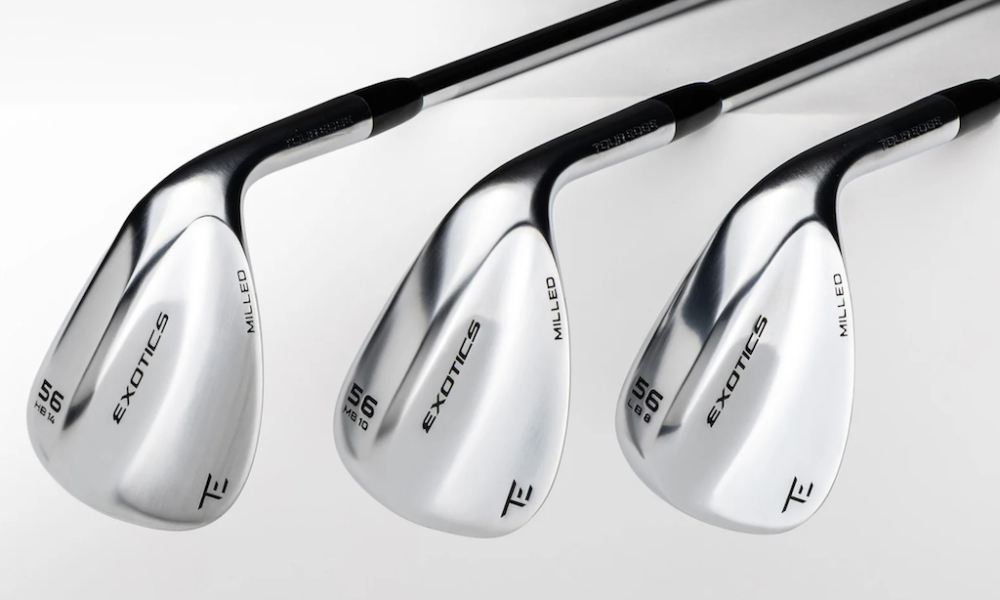
Tour Edge recently launched its Exotics Milled wedges, designed for golfers seeking a versatile tool for their short game. The development team focused on providing a wide array of sole configurations to accommodate various swing styles, course conditions, and shot requirements. Full details regarding the release can be found in our launch article HERE.
Upon unboxing, I was struck by the clean, traditional aesthetic Tour Edge chose for this line. While previous iterations featured unique shapes and cosmetic designs, these Exotics Milled wedges offer the refined look that better players prefer both at address and in the bag. Looking down at the club, you see a classic profile with a slightly elongated heel-to-toe measurement. The leading edge is notably straight, and the design features zero offset.
The combination of a satin finish and a milled face minimizes glare, though I did notice a slight reflection at one specific angle. This occurred only once during my testing and did not repeat throughout my rounds. Regarding the milled face, the aggressive texture is clearly designed to generate maximum spin from any lie.
On the course, the Exotics Milled wedges proved to be high-level performers. I tested a 56-degree Mid Bounce (MB) model and was generally impressed. The conditions were wet, and while there was no standing water, the fairways were quite soft. I was pleased with how the 10 degrees of bounce on the MB handled both the soft turf and the damp rough.
The pre-worn leading edge allowed the wedge to glide through the turf without digging, and it performed well in deep rough. The club felt smooth and fast, navigating various lies across the course with ease. I found that when the ball was buried in the rough, I could strike down on it effectively, and when the ball was sitting up, the sole prevented the club from sliding underneath it.
The Exotics Milled wedges excelled out of the rough, helping me maximize those difficult lies. Because the sand traps were firm and compact due to recent rain, I initially hit my first shot low on the face and over the green. Once I adjusted my entry point, however, I was able to execute high-quality bunker shots. The sole is particularly effective for square-faced shots, though it remains versatile enough to open up for higher-lofted attempts.
Spin rates were consistently high, providing excellent control. From clean fairway lies, shots checked up quickly with minimal release. Full swings resulted in significant spin back, while partial shots stopped almost immediately next to the ball mark. As expected, the deep rough reduced spin, yet I maintained enough control to predict the rollout accurately. Even short pitch and chip shots checked up well before releasing toward the hole. I hit one shot over a bunker with the face slightly open that landed softly and rolled out only two or three feet. This soft landing capability allows you to play more aggressively and stick shots closer to the pin from various locations.
With a starting price of $120, these Exotics Milled wedges represent one of the best values in the golf market. The 304 stainless steel construction provides a soft feel, and the thoughtful sole options help players select the right fit for their specific game. If you are in the market for new wedges this year, the Tour Edge Exotics Milled is certainly worth a try around the greens.
In mid-July, I participated in Final Qualifying for the U.S. Amateur at Emerald Valley Golf Course in Creswell, Oregon, located near L.A.B. Golf’s headquarters.
After speaking with my friend Jamie, he arranged for me to visit the L.A.B. headquarters to get fitted for a putter. While getting a fitting right before a qualifier might seem excessive, I wanted to use the company’s technology to support my stroke with objective data.
I met with Calvin Green and Cade Stubbs, both skilled players who have performed thousands of fittings for L.A.B. putters. Entering their fitting studio felt like being a kid in a candy store.
For the fitting, I chose a look similar to my traditional putter: a mallet with a single line and alignment aids on the back. This matched the style of the new VZN.1. I tested several shafts, including steel, Gears, Diamana, and TPT. I prefer a firm feel with an audible click at impact, and the VZN.1 paired with a TPT shaft provided exactly that.
Using Quintic putting analysis, I determined that I did not need a forward-press grip and that zero shaft lean was optimal for my stroke. It was enlightening to observe my tempo and see the ball roll71-degree lie angle
Calvin and Cade had me hit putts from 30 feet, 15 feet, and the challenging 4-foot range. It was helpful to see how the putter and I interacted in each scenario. I opted for the heavier weight, which aligns with the putters I have used for years.
Brian Parks, VP of Engineering at L.A.B., explained that the brain interprets torque as weight. This explains why players who first pick up an L.A.B. putter might describe it as feeling light; it is actually the absence of torque, even though the putter head is heavier than traditional models.
When the putter arrived, I headed to the practice green to test the VZN.1 with the TPT shaft. With the balanced feel, I spent 20 minutes hitting long putts. It required discipline to keep going as I practiced 40-footers and beyond. A highlight was sinking a putt from 37 paces. The sound and feel were exactly what I wanted, offering a firm, stable sensation with the TPT shaft.
I then moved on to 15-to-25-foot putts to refine my speed control, followed by using a string for putts of 8 feet and in. It felt great, so I took it to the course.
A few days later, I used the putter for its first round. It felt excellent, and the new club added a sense of excitement to the day. I rolled the ball beautifully. One thing I noticed with the VZN is that the ball rolls end-over-end throughout the entire putt. The ball looks the same at the end of the roll as it did when I first marked it.
During my first few rounds, I made more mid-range putts and was very consistent on short putts. If anything, I occasionally rolled the ball a few feet past the hole because it was tracking so well. With this putter, the ball seems to lose speed while still rolling toward the hole because the end-over-end motion is so pure.
I have been using the putter for three weeks and am thoroughly enjoying it. My speed control and line have been excellent. Knowing the ball rolls true means I have to take responsibility for my green reading. The L.A.B. Golf team also advised me to use lighter thumb pressure during the stroke, which allows the putter to swing freely and utilize its technology. Thumb pressure is often associated with putter head torque and an arcing stroke, so this was a helpful reminder that grip pressure affects all clubs.
So far, the results on the greens have been positive, and the fitting provided insights I can continue to apply on the course. The process of optimization is always ongoing.
Zero-torque putters are currently the most popular trend in golf, but veteran engineer Guerin Rife had a different vision. Rather than eliminating all torque, he sought to control it to keep the putter face square to the target. This engineering goal led to the creation of the Evnroll EZPZ Reverse Torque putter.
What is Reverse Torque? Rife shifted 60 percent of the putter’s mass below the shaft axis to create heel-down weighting. This design helps keep the putter face in the “Square Zone” longer by slowing down face rotation at impact. The Square Zone is the window of time and space where the face points toward the target as the putter approaches the ball. Evnroll’s data suggests that this design keeps the face square to the target for twice as long, resulting in tighter starting lines and more consistent putts.
“Zero Torque has been in the spotlight and has quickly been embraced by the industry,” said Guerin Rife, founder and chief designer of Evnroll. “While reducing torque is a good thing, I believe “reversing torque” is even better. Reverse Torque allows golfers to keep the familiar look and setup of a traditional putter while naturally slowing face rotation through impact. The difference is something golfers can feel immediately.”
The EZPZ is not a traditional putter, yet it retains features that many zero-torque models lack, such as a standard L-neck plumbers hosel that provides full shaft offset.
At address, it resembles a high-MOI mallet. The milling is high quality, and the Sweet Face 2.0 technology is impressive. While some may find the design busy, the pursuit of stability and forgiveness often necessitates non-standard shapes.
On the practice green, I quickly felt comfortable and was not distracted by the putter’s appearance. Evnroll’s inclusion of a premium UST Mamiya All-In shaft is a smart choice; I appreciate the feel and performance of these graphite shafts. The gloss black finish complements the head, and the chrome tip transitions smoothly into the silver hosel.
My first putt highlighted how stable the putter felt. While face-balanced putters are generally stable, this felt amplified. Throughout my stroke, the EZPZ felt as though it were on rails, staying true to its line. My stroke has a slight arc, closer to straight-back-straight-through, and the putter complemented it perfectly. I never felt the need to fight the club or adjust my mechanics to achieve a smooth stroke.
The beauty of Reverse Torque is that it works in the background, allowing you to simply make your natural stroke. It doesn’t alter the feel like some zero-torque models; it just feels like an exceptionally stable mallet. While I didn’t hole every putt, I performed very well with the EZPZ. My line was consistent, and even on off-center strikes, the ball stayed on track. If a putt missed, it was usually right next to the hole.
This putter is remarkably easy to use and consistently starts the ball on my intended line. Combined with Evnroll’s Sweet Face 2.0, which promotes a smooth forward roll and consistent ball speed, it offers a great chance to make more putts.
Although the aesthetics are somewhat busy, the alignment markings are well-executed. The white sight lines and dot contrast clearly against the black head, making it easy to align with the target. Any misalignment was immediately obvious and easily corrected before the stroke.
Multi-material heads can sometimes suffer from poor sound or feel, especially with protruding wings. Rife and his team successfully minimized harsh or ringing sounds at impact. The putter actually felt crisper than I anticipated. While grooved faces like Sweet Face 2.0 often feel soft due to reduced metal contact, the EZPZ provided a firm, responsive click that golfers who value feedback will appreciate. It is not a dead-feeling mallet; you receive clear feedback through your hands and ears.
I have long been a fan of the UST Mamiya All-In shaft, and it pairs well with the EZPZ. The stiff profile provides a clear sense of the putter head’s position, and the graphite construction dampens vibrations. The NEO pistol-style grip is the final touch, offering a tacky feel with a flat top and sharp edges that provide excellent hand awareness, even in hot and humid conditions.
Evnroll has succeeded in creating a putter that uses technology to improve consistency. From the precise milling and weight distribution to the traditional hosel, golfers who have struggled with zero-torque designs but still want more assistance on the greens may find Reverse Torque to be the solution. I am very impressed with its performance.
Cleveland Golf recently released the new RTZ 2 wedges, successfully retaining the strengths of the original RTZ while incorporating enhancements from Roger Cleveland. The question remains: do these new wedges live up to Cleveland’s high standards?
I tested a set of RTZ 2 wedges for 26 holes to evaluate their performance.
When I opened the box, I was impressed by the clean, subtle graphics and the three available finishes. The overall shape remains quintessentially Cleveland, closely resembling the previous model with one notable exception: the leading edge.
Cleveland has opted for a slightly straighter leading edge, a change I personally appreciate. I expected the continued use of Z-Alloy to provide the same soft feel as the original RTZ, and I was not disappointed. Well-struck shots feel soft, similar to a forged wedge, while mishits are not overly firm or clicky. Even traditionalists should be pleased with the look and feel of the RTZ 2.
High expectations are natural for a new Cleveland wedge, and the RTZ 2 met them without issue. Spin was consistently high from all lies. In the lush, long rough common in Metro Detroit, the RTZ 2 kept shots tight and predictable.
From deep lies, the ball would release, but the rollout was consistent and never runaway. Compared to other wedges, the RTZ 2 retains spin from the rough quite well. From the fairway, expect little to no release, so you should aim directly at your target. Even partial shots landed softly and stopped almost immediately. The ball flight is mid-launch; it is easy to hit high, but you can also flight the ball down while maintaining high spin.
I tested both the Mid and 588 soles, and both performed well in Michigan’s soft conditions. The Mid sole is stable on full shots and offers good turf interaction without excessive digging.
On the 50-degree wedge, the Mid sole is excellent for full swings, while the Mid sole on the 58-degree model features additional relief on the heel, trailing edge, and toe. This relief allows for versatility around the green while keeping the leading edge low for clean contact. The 588 sole is listed with 8 degrees of bounce but plays like more; I never experienced issues with digging on soft fairways. It moves through the turf quickly and is surprisingly versatile.
While the leading edge does not sit flush with the turf when the face is opened wide, it provides extra bounce for float in soft sand or deep rough. There are numerous other grind options available to suit various swings, conditions, and shot preferences.
Roger Cleveland’s return to help develop the RTZ 2 has resulted in a fantastic set of wedges. Subtle shaping adjustments provide a great look from every angle, while the new ZipCoreIQ maintains consistent center-of-gravity placement for optimal performance. Each shot feels and sounds soft, and the face and groove technology deliver impressive spin from any lie. With the variety of grinds and finishes offered, there is an RTZ 2 wedge for every type of player.