
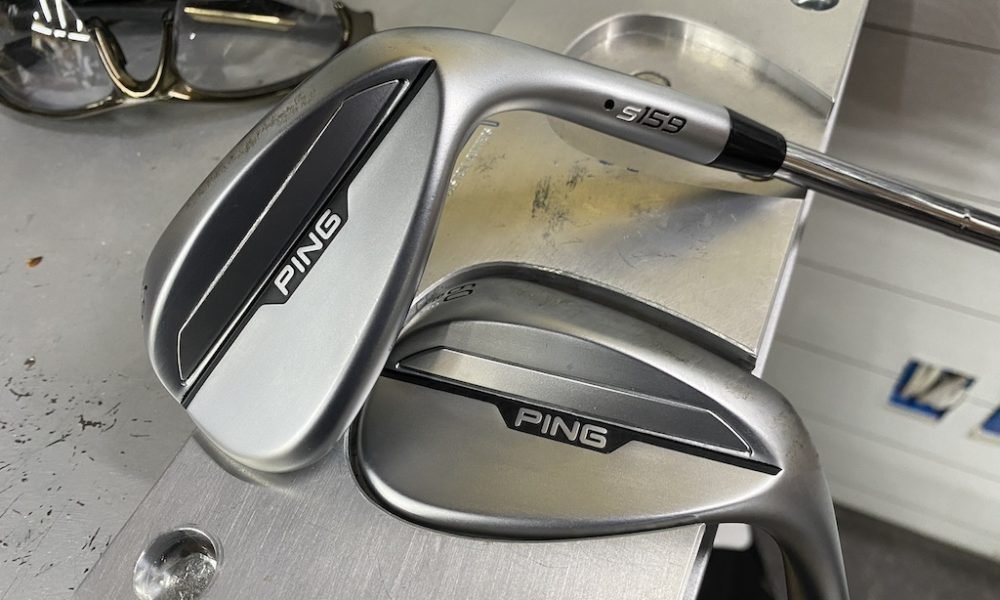
Ping’s new S159 wedges have been a frequent topic of conversation on the GolfWRX forums since they were first spotted on tour late last year. I was lucky enough to test two of the latest S159 grinds on the course to see how they performed around the greens. While some of Ping’s previous wedge designs never quite appealed to me, that changed immediately with the S159 series.
For a more in-depth discussion and a full review, please check out the Club Junkie podcast on all podcast platforms and YouTube below.
Out of the box, I appreciate the clean, straightforward aesthetic Ping chose. From the address position, the wedges feature reduced offset, and the transition from the hosel to the leading edge is perfectly straight. Many wedges with slight offset have a curved or “hooked” look between the hosel and leading edge that I personally dislike. Ping, however, has eliminated most of that.
Regarding the leading edge, Ping has opted for a straighter design; there is very little curvature on the lower lofts, such as the 52-degree, with only a slight increase in radius as you move into the lob wedge. I enjoy the minimalist branding, and the Hydropearl 2.0 chrome finish looks sharp while effectively minimizing glare.
Ping has introduced several new grind options to the S159 lineup. If you are unsure which wedge best suits your game, Ping’s WebFit app is a fast way to receive tailored recommendations.
I have been testing the 56 H grind and 60 B grind. These wedges are cast from 8620 carbon steel, providing a pleasantly soft feel. When you strike the ball away from the center, you will notice increased vibration in your hands and a more audible click at impact. My typical miss with a wedge is low on the heel, and I definitely noticed a firmer sensation and louder sound on those strikes.
Spin performance on the S159 was excellent, and Ping’s use of smaller grooves on the face allowed shots to check up quickly from various distances. Because the smaller grooves can be tricky to clean, I recommend using a quality plastic-bristled brush. Playing early in the season in Metro Detroit means dealing with less-than-perfect fairway lies, yet the S159 wedges still allowed me to spin the ball back on full shots. Even from the rough, the ball spun well and produced a predictable, albeit shorter, release. I once landed a bit long on a green with very little space to work with; I hit a short chip that landed just past the fringe and stopped after only a foot, leaving me well short. I didn’t expect the wedge to generate enough friction from that thick rough, but the S159 proved me wrong.
Ball flight is slightly higher than the Vokey SM10 wedges on standard shots, but it remains easy to flight the ball down for a penetrating shot with plenty of spin. Ping describes the S159 shape as tour-inspired, yet they still offer significant forgiveness on off-center hits. As I mentioned, I tend to miss low on the heel, and the S159 still provided decent launch and spin, resulting in a solid outcome.
I was initially intimidated by this model, as I haven’t played a sand wedge with such low bounce in a long time. I have a steeper swing and typically play in soft conditions, so most of my wedges usually have bounce ratings in the teens. However, Ping describes the H as “A shot-saving option for players with steeper angles of attack who like to manipulate the handle and play with versatility,” so I didn’t need to be so cautious.
The H grind provided good turf interaction on full shots; even with the course softened by recent rain, the wedge moved through the ground quickly. My divots were slightly deeper than with my higher-bounce wedges, but the H cleared the turf without issue.
Around the green, the H grind was versatile, allowing me to open the face while keeping the leading edge close to the turf. I don’t open a 56-degree wedge very often, but it was simple to open it slightly for higher-lofted pitch or chip shots. When I opened the face fully in the bunker, the wedge offered great float and slid through firm sand with ease.
This was the grind I was most eager to test, though I was surprised by the width of the sole. While I am nowhere near the skill level of a tour player capable of hitting flop shots off concrete, I do enjoy opening the face occasionally. The B grind is wide and features only minimal heel and trailing edge relief. As Ping notes, the grind is “For a shallow angle of attack and neutral face delivery. Low-bounce design sits low on the turf on square-face shots.”
The B grind features a subtle bevel from the leading edge to the sole, which allows the wedge to be “thumped” into the turf without digging when played square. As Ping says, square shots are great and you have a bit of forgivness if you hit just slightly behind the ball as the B will glide effortlessly across the turf. You can still open the face slightly in softer, lush conditions. Shots struck high on the face don’t carry as far and lose some spin compared to high-toe style wedges.
The B grind excels in bunkers with soft, fluffy sand, where it floats like a pontoon boat. I typically use a 56-degree wedge from the sand unless I am short-sided, but I could see myself using the B grind more frequently because it is so consistent and easy to use.
My final thoughts on Ping’s S159 wedges: They are highly versatile and suitable for a wide range of golfers. Whether you want elite shotmaking capabilities or just consistent wedges that spin reliably, these fit the bill. With the new variety of grinds now available, you should have no trouble building a two, three, or four-wedge set that complements your swing and local course conditions.
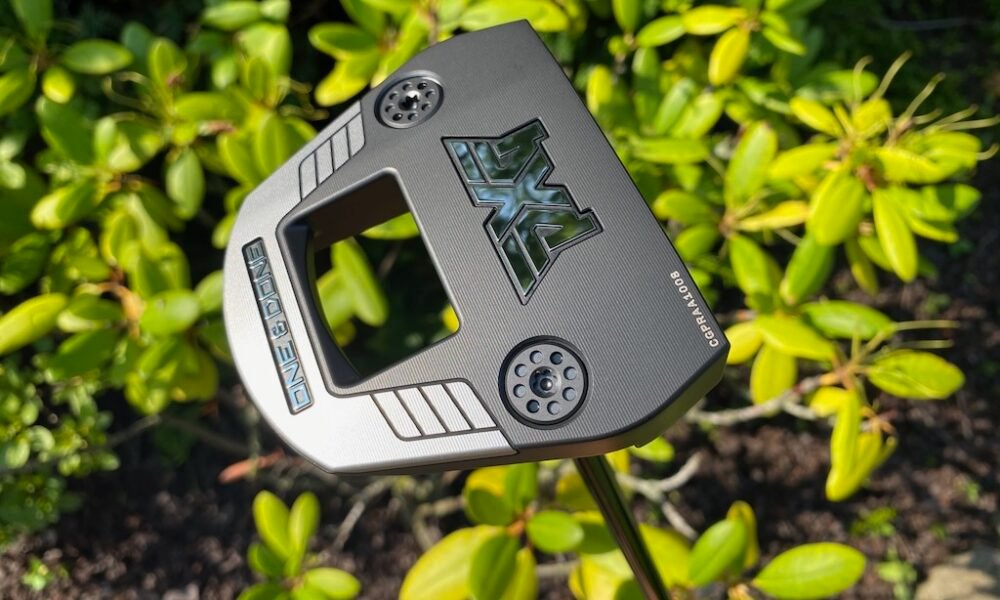
If you haven’t noticed, PXG has built up an impressive collection of zero-torque putter options. Their zero-torque lineup now includes six head shapes, including blades and mallets, since the initial release of the Allan ZT putter in 2024. PXG is giving golfers tons of options to get fit for the putter that fits them best, no matter their putter style and look preference. This One & Done ZT is the newest putter in the line and, to me, one of the most stable feeling.
If you can call a ZT putter traditional-looking, then the One & Done falls into that category for me. While this putter has the typical center shaft location, it is a bit more of a traditional mallet shape. From the toe and heel, the One & Done slants toward the rounded back of the putter, giving it a fairly soft, comfortable look from address. The rectangular opening in the head works well with the three alignment lines to frame the putter behind the ball. My One & Done ZT putter has a black M16 shaft and gives it a great, stealthy look while also hiding a little of that center shaft placement. I like the look of the One & Done ZT, and with all of the ZT putters I have tested, this is one of my favorites to look down at.
PXG uses their Multi-Material Hollow construction in order to increase performance and make a putter sound and feel good. Sound and feel are where I think PXG doesn’t get enough credit with their putters, and using the same S-Core polymer that they have used in their irons works great. The One & Done ZT has a nice soft feel that isn’t too mushy like you might get with an insert; you still get good responsiveness off the face. Even with a firmer ball like the Titleist Pro V1x, you get a soft feel and just a small click off the face. The sound stays fairly consistent on misses as well, while your hands get the feel of a little firmer strike when your impact is off-center. I have always thought that PXG putters have felt and sounded really good, and the One & Done keeps going with that tradition.
Rolling putts with the One & Done ZT was a great experience from the first putt. I am a huge fan of the PXG Hot Rod ZT and Bat Attack ZT, but this putter might feel the most stable out of those options. I like zero-torque putters that have a feeling of the face putting the putter through the stroke and into impact. The PXG Allan ZT has less of that feeling and with talking to golfers who have more arc in their putting stroke, they tend to love that more neutral feeling.
I was surprised that the One & Done ZT had such a stable feeling because it is so much more compact than the Hot Rod ZT. The PXG engineers worked some magic with that Multi-Material Hollow construction to make this putter feel like it will fight going off-line with all its might. To me, this putter is the cliché of just pull it back and let the club do the work; it is that easy. Putts that failed to hit the center of the face stayed online really well and you just don’t feel the head wanting to open or close when the impact is on the toe or heel. PXG’s Pyramid Face Pattern puts a great, consistent roll on the ball every time, so you are hitting consistent putts at the cup. I played a lot in the early morning, and you can easily see when a putter makes a ball hop or skip through the dew. Each putt with the One & Done ZT was smooth and on line to give me the best chance at making the putt.
Distance control and speed are pretty average; you don’t get balls that come off the face too hot with the Pyramid Face like you can with some insert designs. Alignment was also very easy and comfortable with the three simple white lines on the top. The combination of those lines and the center opening works well together to ensure that the putter is lined up towards your target. Now, the One & Done ZT does have 2 degrees of forward shaft lean, and not everyone works well with that design. For me, it is perfect, since the first ZT putter I used had that lean, and I have gotten used to it. PXG offers a few slanted grip styles to help get the hands in a more natural and comfortable position to offset that lean.
Overall, I think the PXG One & Done ZT is one of the better zero-torque putters on the market. The more traditional head shape, stability through the stroke, and soft feel make it a strong competitor in a crowded space. With PXG including a lot of custom options for fitting this putter, the One & Done ZT can provide a wide range of golfers with more consistent putts that hopefully find the bottom of the cup more often.
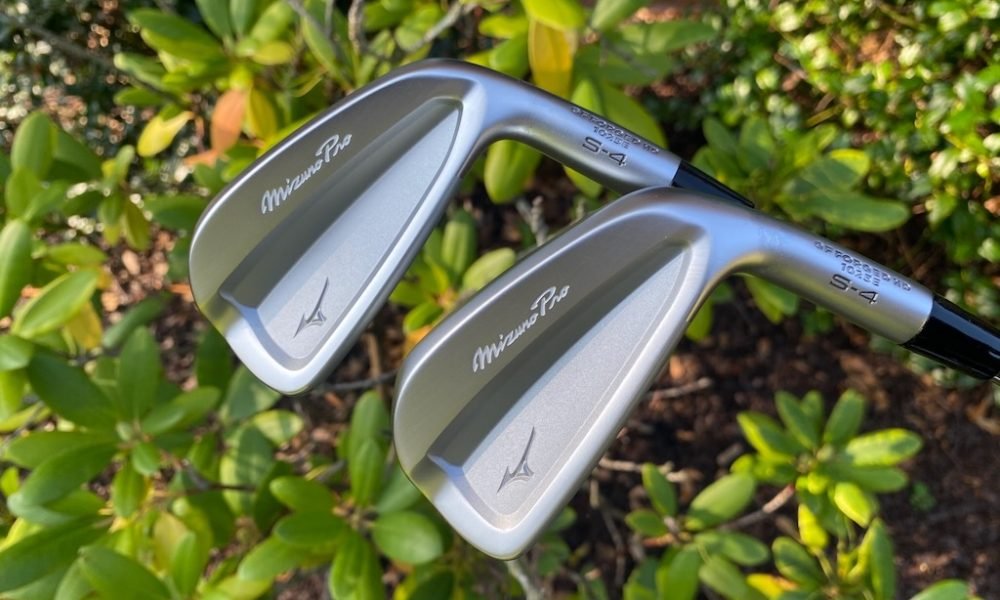
Mizuno recently launched the latest addition to its Signature iron series, the Pro S-4. The Signature line offers a unique approach in the iron market, providing various options for skilled players to find their ideal fit through subtle design differences. Mizuno also intends to keep these models in their lineup for several years, allowing golfers to maintain a consistent set that works for them. You can check out our full launch article with all of the details on the new Pro S-4 irons here.
Upon unboxing the irons, I was met with the familiar White Satin Brush Finish that Mizuno utilized on the previous Pro S-1 and Pro S-3 Signature models. I appreciate this finish, as it offers a classic chrome aesthetic with a glare-reducing texture that looks excellent at address.
To be transparent, these irons do feature some offset for players who prefer or require it. Many high-level players actually prefer a bit of offset in their irons. The offset is not excessive, and honestly, it becomes unnoticeable after just a few swings. The overall shape is impressive, featuring a compact look and a slightly shorter blade length than the Pro S-3. The topline is thin, and the toe has a slightly sharper profile that I believe better players will appreciate.
Mizuno states that the new Pro S-4 features a lower center of gravity for improved launch and forgiveness, and you can certainly feel it during play. For me, the launch window was nice and high, comparable to the players-distance irons I have been using recently. Even when impact was low on the face, the result was a high-launching shot with enough stopping power for the greens.
The 4-iron still flew a bit flatter than I would prefer, but at this stage in my golf journey, I would likely replace that with a utility iron or hybrid for better consistency. Control remained excellent, and the increased launch, combined with the spin generated, resulted in shots with very little rollout on the green. Even from thick rough, shots landed on the green and stopped near their pitch marks, giving me the confidence to be more aggressive with my approach shots.
Forgiveness is definitely improved for a single-piece forged cavity back, and I find the Pro S-4 to be very playable for this category of iron. My misses, which usually occur low on the face or toward the toe, flew much straighter and higher than anticipated. When I made contact low on the face, the balls still ended up either just in front of the green or on the front edge.
Those misses didn’t leave me in the difficult positions I sometimes encounter when playing irons that lack a face designed to maintain ball speed. Center strikes feel incredible, as you would expect from a Mizuno forging with a copper underlay. Each well-struck shot was met with a satisfying thud and the sensation of the ball compressing against the face.
Turf interaction is excellent thanks to Mizuno’s Triple Cut sole. During my testing, Michigan experienced several wet days that softened the courses significantly. I tend to be a bit steep with my iron swings, but the Triple Cut sole kept my divots shallow and controlled, preventing the iron from digging or slowing down at the bottom of the swing. Even on average fairways, the sole moved through the turf effortlessly, and I never felt hindered in my ability to make clean contact in the center of the face.
Overall, the Mizuno Pro S-4 irons are a great addition to the Signature lineup. Their higher-launching design and added forgiveness provide skilled players—though I am not one of them—another option to dial in their equipment. There is enough distinction between these and the Pro S-3 for both to coexist, and players will naturally gravitate toward the model that best suits their needs.
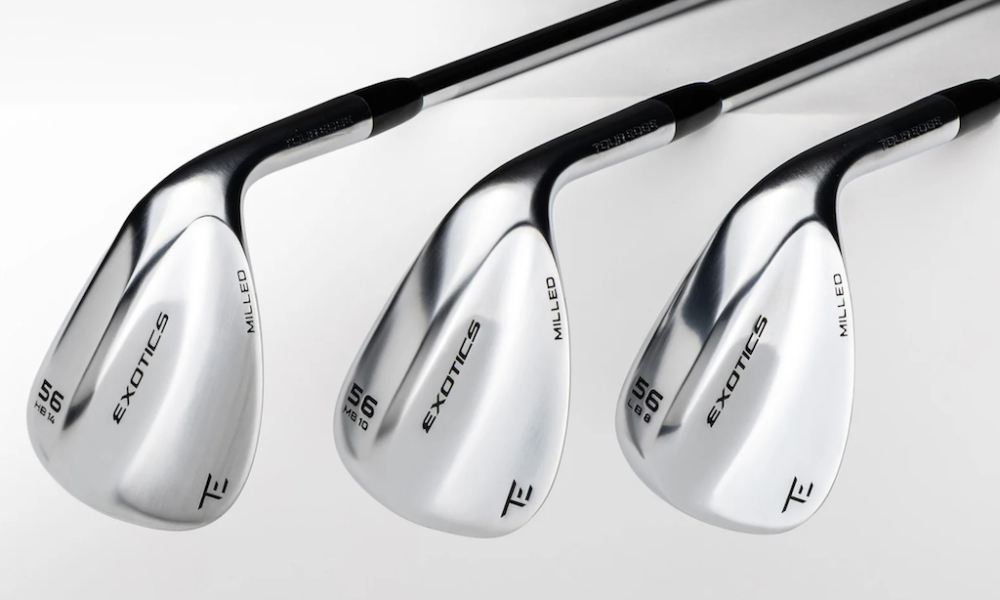
Tour Edge recently debuted its new Exotics Milled wedges for golfers seeking a versatile tool for their short game. The team invested significant effort into providing a wide range of sole options to accommodate various course conditions, swing styles, and shot types. You can find the full details in our launch article HERE.
Taking the wedges out of the box, I was impressed by the clean, traditional aesthetic Tour Edge chose. Their previous wedges featured more unique looks in terms of shape and cosmetics. These Exotics Milled wedges offer the classic appearance that better players expect both at address and in the bag. Looking down at the wedges, you get a traditional profile with a slightly longer heel-to-toe length. The leading edge is quite straight, and the Exotics Milled features zero offset.
A nice satin finish and milled face minimize most glare, though you might catch a tiny bit of brightness at the perfect angle. That only happened once for me and never occurred again during my rounds. Speaking of the milled face, you can really see the aggressive effort to create a wedge that produces maximum spin from any lie.
On the course, the Exotics Milled are high-level performers. I tested a 56-degree Mid Bounce (MB) wedge and was generally impressed. It was a wet day, and while there was no standing water, the fairways were quite soft. I was genuinely impressed by how the 10 degrees of bounce on the MB handled the soft fairways and wet rough.
The pre-worn leading edge helped the wedge glide through the turf without digging, and it performed well in deep rough. The wedge moved through most lies across the course smoothly and quickly. I noticed that when the ball was buried in the rough, I could really strike down on it for a solid shot, and when the ball was sitting up, the sole prevented me from sliding underneath it.
The Exotics Milled wedges really excelled out of the rough, allowing me to make the most of those difficult lies. The sand traps were extremely firm and compact due to the rain, so I hit my first shot a bit low on the face and over the green. After that, I adjusted, and as long as I maintained the correct entry point, I hit some very nice bunker shots. The sole performs best on shots played square to the target, but you can still open it up for higher-lofted shots.
Spin on the course was definitely high, providing plenty of control. Clean fairway lies resulted in shots that checked up quickly with little to no release. Full shots would hit and spin back significantly, while partial shots stopped right next to their ball marks. The deep rough reduced the spin somewhat, as expected, but I still maintained control and could easily predict the rollout. Even small pitch and chip shots checked up well before releasing toward the hole. I hit a shot over a bunker with the face slightly open that landed on the green and barely rolled more than 2-3 feet. That soft landing allows you to be more aggressive and get your shots closer to the hole from anywhere.
At a starting price of $120, these Exotics Milled wedges represent one of the best values in golf. The 304 stainless steel construction provides a soft feel, and the thoughtful sole designs help players select the best wedge for their specific game. If you are in the market for new wedges this year, you should definitely give the Tour Edge Exotics Milled a try around the greens.