


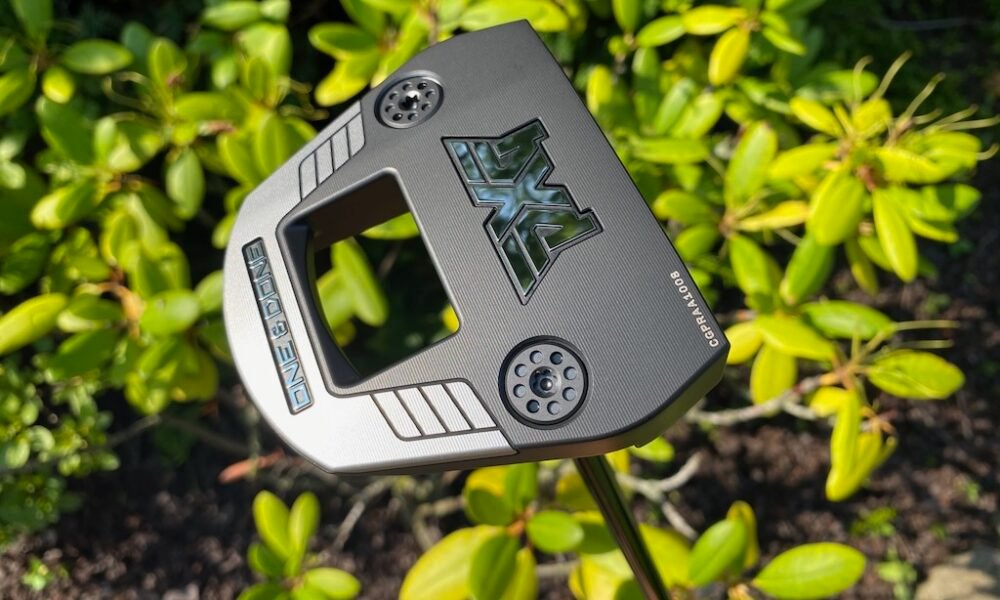
PXG has developed a compelling lineup of zero-torque putters. Since the 2024 debut of the Allan ZT model, the company has expanded its range to include six different head shapes, covering both blades and mallets. This variety allows golfers to find a fit that matches their personal aesthetic and stroke style. The One & Done ZT is the latest addition to this series, and in my experience, it offers some of the most stable performance yet.
If a zero-torque putter can be described as traditional, the One & Done fits the bill. While it features the expected center-shaft configuration, the head shape leans toward a classic mallet design. The toe and heel areas taper toward the rounded back, creating a soft, inviting profile at address. A rectangular cutout in the head pairs nicely with three alignment lines to frame the ball effectively. My test model features a black M16 shaft, which provides a stealthy appearance while subtly masking the center-shaft entry point. I find the One & Done ZT to be one of the most visually appealing putters in the entire ZT collection.
PXG utilizes its Multi-Material Hollow construction to enhance both performance and acoustics. I believe PXG is often overlooked regarding the sound and feel of their putters; the integration of the same S-Core polymer found in their irons works exceptionally well here. The One & Done ZT delivers a soft sensation that avoids the “mushy” feel often associated with inserts, maintaining a high level of responsiveness off the face. Even when using a firmer ball like the Titleist Pro V1x, the feedback remains soft with a crisp, subtle click. The sound remains consistent on off-center hits, though the hands will detect a firmer sensation on mis-hits. PXG has a strong track record for feel and sound, and this model continues that legacy.
Rolling putts with the One & Done ZT was a positive experience from the very first stroke. While I am a fan of the PXG Hot Rod ZT and Bat Attack ZT, this model feels the most stable of the group. I prefer zero-torque putters that provide the sensation of the face driving through the stroke and into the ball. The PXG Allan ZT offers less of that sensation, which golfers with an arcing stroke tend to prefer for its neutral feel.
I was surprised by the stability of the One & Done ZT, especially given its more compact footprint compared to the Hot Rod ZT. PXG’s engineers have utilized their Multi-Material Hollow construction to create a head that resists twisting off-line. It embodies the classic advice to simply pull the putter back and let the club do the work. Putts struck away from the center stayed on their intended path, with no noticeable tendency for the head to open or close on toe or heel strikes. The Pyramid Face Pattern ensures a consistent roll, helping to keep putts on track toward the cup. Testing during early morning rounds, where dew makes it easy to spot ball hopping or skipping, confirmed that the One & Done ZT produces a smooth, true roll.
Speed and distance control are quite balanced; the Pyramid Face does not produce the “hot” off-the-face reaction sometimes found in insert-based designs. Alignment is straightforward thanks to the three white lines on the crown. These markings, combined with the center opening, make it easy to square the putter to the target. It is worth noting that the One & Done ZT features 2 degrees of forward shaft lean, which may not suit every golfer. I have grown accustomed to this design through previous ZT models, so it feels natural to me. PXG also provides various slanted grip options to help players achieve a comfortable hand position that compensates for the lean.
Overall, the PXG One & Done ZT stands out as a top-tier zero-torque option. Its classic head shape, stability, and soft feel make it a formidable choice in a competitive market. With PXG’s extensive custom fitting options, the One & Done ZT is well-positioned to help a wide range of golfers achieve greater consistency on the greens.
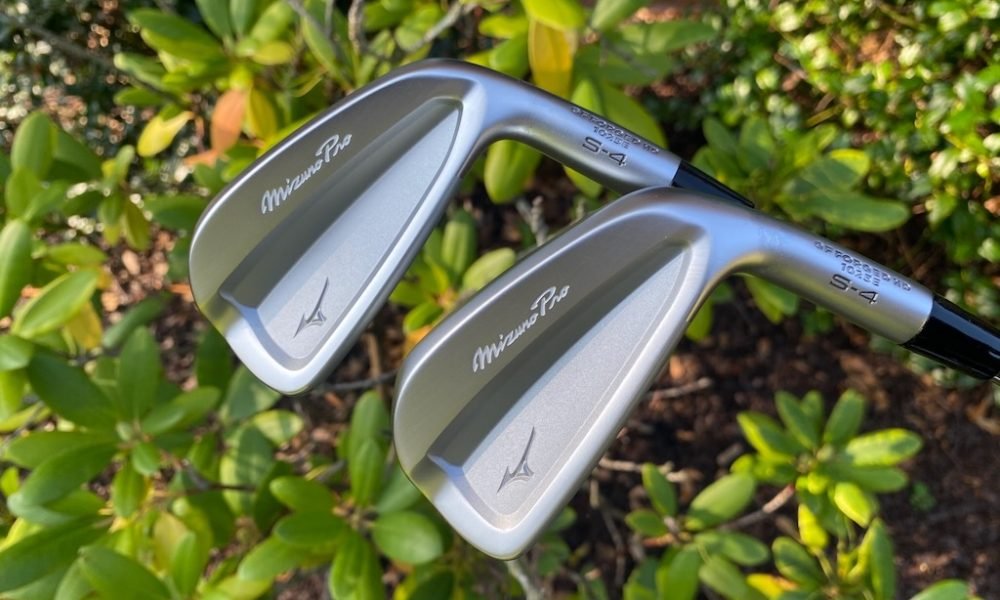
Mizuno recently launched the Pro S-4, the latest addition to its Signature line of irons. This series offers a unique approach in the iron market, providing skilled players with multiple options that feature subtle, performance-focused differences. Mizuno intends to keep these irons in its catalog for several years, allowing golfers to stick with the set that best suits their game.
Upon unboxing, I was met with the familiar White Satin Brush Finish seen on the previous Pro S-1 and Pro S-3 models. I appreciate this aesthetic, as it offers a classic chrome look while providing a glare-resistant texture that performs well at address.
To be clear, these irons do feature some offset for players who prefer or require it. Many skilled golfers actually favor a bit of offset, and in this case, it is subtle enough that it blends into the clubhead after only a few swings. The overall shape is excellent, featuring a compact profile and a slightly shorter blade length than the Pro S-3. The topline is thin, and the toe has a sharper, more refined look that better players will likely enjoy.
Mizuno designed the Pro S-4 with a lower center of gravity to improve launch and forgiveness, and the difference is noticeable. My launch window was consistently high, comparable to the players-distance irons I have been using lately. Even on shots struck low on the face, the ball launched high and maintained enough stopping power for the greens.
The 4-iron produced a flatter trajectory than I prefer, though at this stage in my golf journey, I would likely replace it with a utility iron or hybrid for better consistency. Control remained high, and the combination of launch and spin resulted in minimal release upon landing. Even from thick rough, shots hit the green and settled near their pitch marks, which gave me the confidence to play more aggressively.
Forgiveness is impressive for a single-piece forged cavity back, making the Pro S-4 highly playable for its category. My typical misses—usually low on the face or toward the toe—flew straighter and higher than expected. Even when contact was less than perfect, the ball usually ended up near the front of the green rather than in a difficult spot.
Center strikes feel exceptional, as expected from a Mizuno forging with a copper underlay. Each well-struck shot produces a satisfying thud and the sensation of the ball compressing against the face.
Turf interaction is excellent thanks to the Triple Cut sole. During my testing, Michigan experienced several wet days that softened the courses. Even with my steeper swing, the Triple Cut sole kept my divots shallow and prevented the iron from digging into the turf. On standard fairways, the sole glided through the ground, allowing for clean contact every time.
In summary, the Mizuno Pro S-4 irons are a strong addition to the Signature lineup. Their high-launch characteristics and forgiveness provide skilled players with another excellent tool to dial in their setup. There is enough distinction between these and the Pro S-3 for both to serve different needs, and golfers will naturally gravitate toward the model that best complements their game.
Tour Edge has released its new Exotics Milled wedges, designed for golfers seeking versatility around the green. The team focused on offering a wide range of sole configurations to accommodate various course conditions, swing types, and shot selections.
The wedges feature a clean, traditional aesthetic that is sure to appeal to better players. Unlike some of their previous designs, these Exotics Milled wedges look right at home in any bag. At address, they offer a classic wedge profile with a slightly extended heel-to-toe length. The leading edge is relatively straight, and the design includes zero offset.
The satin finish and milled face effectively minimize glare, with only a rare hint of brightness at specific angles. The aggressive milling on the face is clearly designed to generate maximum spin from any lie.
On the course, the Exotics Milled wedges are high performers. I tested the 56-degree Mid Bounce (MB) model during a wet day with soft fairways. I was impressed by how the 10 degrees of bounce handled the damp conditions.
The pre-worn leading edge allowed the wedge to glide through the turf without digging, and it performed well in deep rough. The wedge felt smooth and fast through various lies. When the ball was buried in the rough, I could strike down firmly for a clean exit, and when the ball was sitting up, the sole prevented the club from sliding underneath.
The Exotics Milled wedges truly excelled out of the rough. The sand traps were firm and compact due to recent rain, which caused me to strike my first shot thin. Once I adjusted my entry point, however, I was able to hit high-quality bunker shots. The sole is particularly effective for square-faced shots, though it remains versatile enough to open up for higher-lofted attempts.
Spin rates were consistently high, providing excellent control. From clean fairway lies, shots checked up quickly with minimal rollout. Full swings produced significant spin, while partial shots stopped promptly near their landing spots. As expected, deep rough reduced spin slightly, but control remained predictable. Even short pitch and chip shots checked up well before releasing toward the hole. I successfully hit a shot over a bunker with an open face that landed softly and rolled only a few feet. This level of control allows for more aggressive play around the greens.
At a starting price of $120, the Exotics Milled wedges represent one of the best values in golf. The 304 stainless steel construction provides a soft feel, and the thoughtful sole designs offer options for every type of player. If you are in the market for new wedges, the Tour Edge Exotics Milled is well worth a try.
In mid-July, I participated in Final Qualifying for the U.S. Amateur at Emerald Valley Golf Course in Creswell, Oregon. L.A.B. Golf’s headquarters are located right on the property, so I reached out to a friend to arrange a visit and a professional putter fitting. Putter fitting right before a qualifier might seem excessive, but I wanted to use their technology to validate my stroke with data.
I met with Calvin Green and Cade Stubbs, who have performed thousands of L.A.B. putter fittings. Walking into their studio was a fantastic experience.
For the fitting, I chose a look similar to what I have traditionally used: a mallet with a single alignment line on the back. This matched the style of the new VZN.1. I tested several shafts, including steel, Gears, Diamana, and TPT. I prefer a firm feel with an audible click, and the VZN.1 paired with a TPT shaft provided exactly that.
Using Quintic putting analysis, I discovered that I did not need a forward-press grip and that zero shaft lean was optimal for my stroke. It was enlightening to see my tempo and the ball-roll data on camera. My final specs included a 71-degree lie angle.
Calvin and Cade had me hit putts from 30 feet, 15 feet, and the short, tricky sliders common on the course. I also opted for a heavier weight, which felt similar to the putter I have used for years.
Brian Parks, VP of Engineering at L.A.B., explained that the brain perceives torque as weight. This is why people often think an L.A.B. putter feels light at first—it is actually the absence of torque, even though the putter head is heavier than traditional models.
When my VZN.1 with the TPT shaft arrived, I headed to the practice green. I spent 20 minutes hitting long putts to get used to the balanced feel. A highlight was holing a putt from 37 paces. The sound and feel were perfect, offering a firm, stable sensation.
I followed this with 15-to-25-foot putts to dial in speed control, then moved to 8-footers and in. It felt great, so I took it to the course.
A few days later, I used the putter for its first round. It felt excellent, and I rolled the ball beautifully. One thing I noticed with the VZN is that the ball rolls end-over-end throughout the entire putt. It looks the same at the end of the roll as it did when I picked up my ball mark.
In my first few rounds, I made more mid-range putts and was very consistent on short ones. Because the ball rolls so well, it often traveled a few feet past the hole, but it always stayed on line.
I have been using the putter for three weeks and am thoroughly enjoying it. Speed control and line have been outstanding. Knowing the ball rolls so true, I now have to focus on my green-reading skills. The L.A.B. Golf team also advised me to use lighter thumb pressure during the stroke, which allows the putter to swing freely and utilize its technology. Thumb pressure is often linked to putter head torque and arcing strokes, so this was a helpful reminder that grip pressure affects every club in the bag.
So far, the results on the greens have been positive, and the insights from the fitting have been invaluable. The journey toward optimization is always ongoing.














2 thoughts on “PXG One & Done ZT putter review”