The Meta Quest 3 stands out as one of our top-rated VR headsets and remains the model we typically suggest for anyone looking to explore the technology. As a more accessible alternative, the Meta Quest 3S is a streamlined version of the Quest 3 that retails for $200 less. Following the discontinuation of the Meta Quest Pro, these two devices now comprise Meta’s entire VR lineup. Both headsets have earned a 4.5-star rating and an Editors’ Choice award. Having tested both units alongside many others, I am here to break down their similarities, highlight their differences, and help you decide which one is the right fit for you.
2,064 by 2,208 (per eye)
1,832 by 1,920 (per eye)
Meta Quest Touch Controllers
Meta Quest Touch Controllers
The most significant distinction between these two models is the cost. The Quest 3S starts at $299.99—matching the launch price of the Quest 2—and includes 128GB of storage, with a 256GB option available for $399.99.
The Quest 3 is priced at $499.99 and comes exclusively with 512GB of storage.
Visually, the Quest 3 and the Quest 3S are nearly indistinguishable, as both utilize a white plastic chassis and a Y-shaped head strap. Because you can swap the straps on either device for the three-point Elite Strap ($69.99) or the Elite Strap With Battery ($129.99), the overall comfort and ergonomics remain consistent across both models.
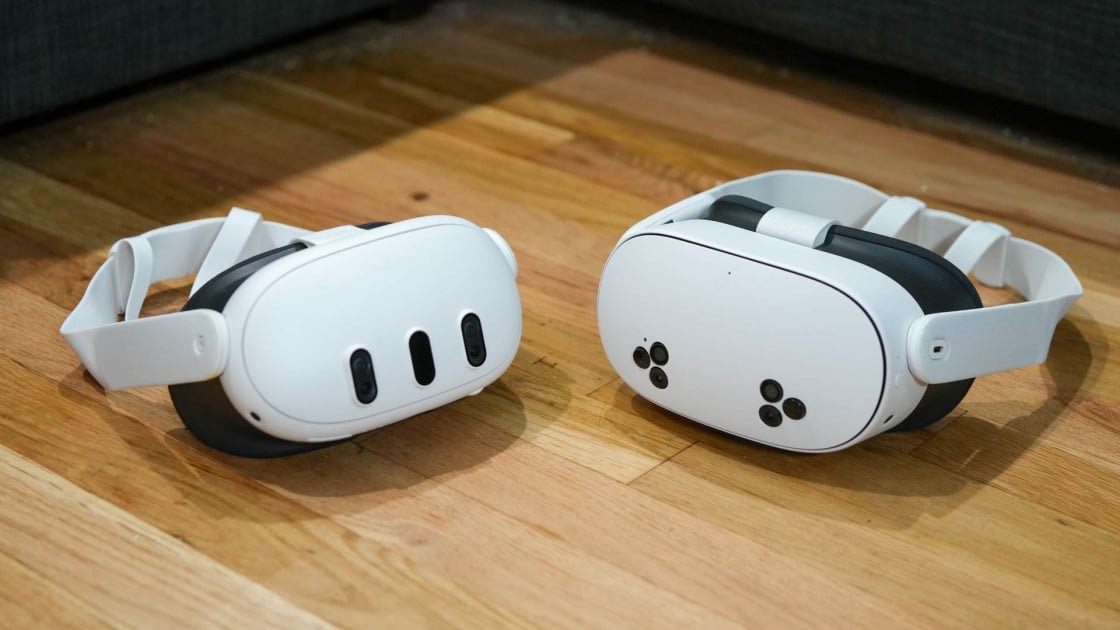
The front panel of the Quest 3 is curved and houses three vertical camera and sensor clusters, whereas the Quest 3S features a flatter front with two triangular clusters. However, these aesthetic variations do not appear to impact motion tracking or the quality of the pass-through view.
The Quest 3S makes its most notable compromise in the display department. It offers a resolution of 1,832 by 1,920 per eye, resulting in 773 pixels per inch. In contrast, the Quest 3 boasts a higher resolution of 2,064 by 2,208, providing 1,218 pixels per inch. Additionally, the Quest 3 provides a wider field of view at 110 by 96 degrees (horizontal and vertical) compared to the 96 by 90 degrees found on the Quest 3S. Both devices support identical refresh rate modes of 72Hz, 90Hz, and 120Hz.
The lenses also differ mechanically; the Quest 3S employs a Fresnel lens with a three-position inter-axial distance (IAD) adjustment similar to the Quest 2, while the Quest 3 utilizes a pancake lens with continuous IAD adjustment. IAD refers to the distance between the lenses, which aligns with your pupillary distance (PD). While PD settings allow for some flexibility and the three-position system on the Quest 3S should accommodate most users, the continuous IAD on the Quest 3 allows for adjustments within a single millimeter for a more precise fit.
While the image quality on the Quest 3S is quite impressive, it appears slightly grainier and offers a narrower perspective than the Quest 3. The more expensive headset provides a clear upgrade in visual fidelity, which helps justify its higher price point.
The Quest 3S joins the Quest 3 in offering color pass-through cameras, a major improvement over the Quest 2. These cameras allow you to view your physical environment in full color, which is highly beneficial for mixed reality or augmented reality applications, or simply for maintaining spatial awareness. Both headsets utilize the same 4MP cameras, which perform reliably, even if they lack the near-perfect clarity of the $3,499 Apple Vision Pro.
Internal hardware remains consistent between the two, as Meta did not compromise on the processor to lower the price of the Quest 3S. Both headsets are powered by the Snapdragon XR2 Gen 2 chip with 8GB of RAM, a robust processor specifically engineered for mixed reality experiences.
Motion tracking capabilities are identical for both the Quest 3 and the Quest 3S. Each device uses outward-facing cameras to monitor the position of the headset and the controllers. Both utilize the same Meta Quest Touch controllers and provide basic hand-tracking support. They perform with equal effectiveness, though users must keep the controllers within the headset’s field of view for active tracking.
The Quest 3S features a smaller battery than the Quest 3, with 4,324mAh compared to 5,060mAh. However, this does not result in shorter usage times. Likely due to the lower-resolution display, Meta reports that the Quest 3S can last approximately 2.5 hours on a single charge, whereas the Quest 3 typically lasts about 2.2 hours.
As noted previously, the Quest 3 provides half a terabyte of storage, while the Quest 3S is available in 128GB or 256GB capacities. Consequently, the Quest 3 offers at least double the storage space of its more budget-friendly counterpart.
Both Meta headsets share the same software ecosystem. They utilize Meta’s VR platform, which hosts hundreds of games and applications. Furthermore, both devices can be connected to a PC for SteamVR or other PC-based gaming using the $79.99 Meta Quest Link Cable.
From a hardware perspective, the Quest 3 is the superior device due to its enhanced display, which sufficiently justifies the $200 price difference. The Quest 3S remains an excellent headset in its own right and offers fantastic value, delivering the same core performance and functionality as the Quest 3. While both are Editors’ Choice <a href="https://shoppixy.com/announcing-the-2025-winners-of-raves-best-of-infocomm-awards/” title=”Announcing the 2025 Winners of rAVe’s Best of InfoComm Awards”>winners, the Quest 3S is the better choice if you want to enter the world of VR without a major financial commitment, whereas the Quest 3 is the premier option for those who want to fully immerse themselves in the technology with the best possible visual experience.