


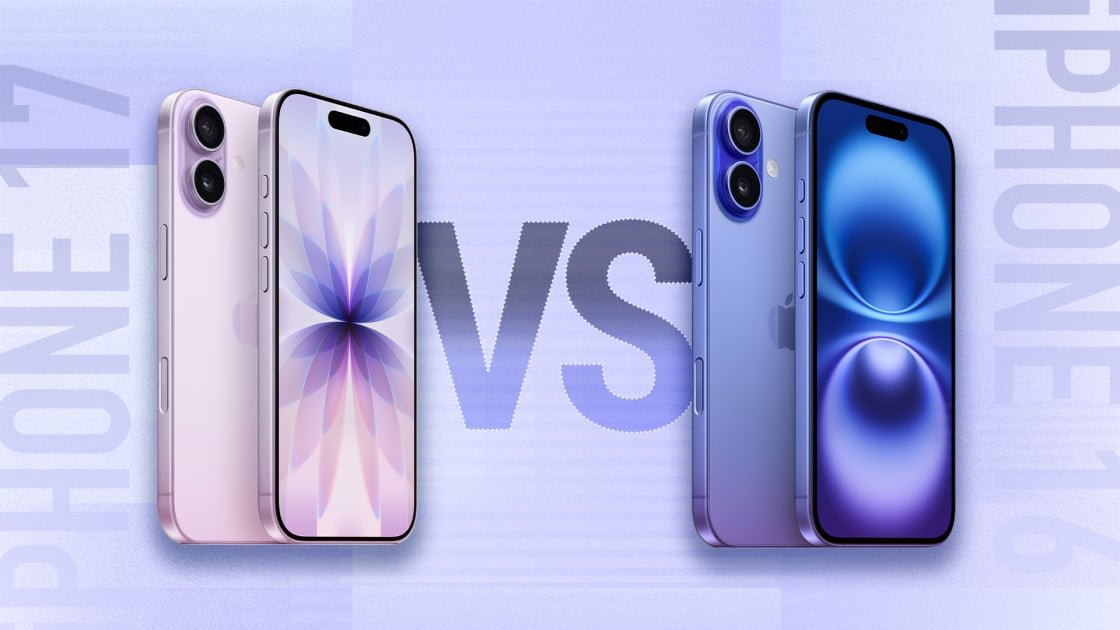
The iPhone 17 lineup represents Apple’s most impressive work to date, though the company continues its tradition of offering the previous year’s model at a reduced price. While the iPhone 17 and iPhone 16 share a similar aesthetic, Apple has implemented substantial upgrades to the 17’s hardware and functionality, narrowing the gap between the standard model and the Pro series while distancing it from the iPhone 16. Although saving $100 is tempting, the iPhone 17 provides significantly more value for that extra investment. If you are deciding between the two, we have thoroughly tested both devices and analyzed the key differences. For those looking to upgrade, we have outlined everything you need to know to make an informed decision.
Apple iPhone 17
Apple iPhone 16
5.89 by 2.81 by 0.31 inches
5.8 by 2.8 by 0.3 inches
2,622 by 1,206 pixels
2,556 by 1,179 pixels
Camera Resolution (Rear; Front-Facing)
48MP, 48MP; 18MP
48MP, 12MP; 12MP
24 hours, 31 minutes
17 hours, 47 minutes
Apple lists the iPhone 17 at $799 for the 256GB model and $999 for the 512GB version. With the arrival of the 17, the iPhone 16 price has been lowered to $699, though this entry-level price only includes 128GB of storage.
If your primary concern is cost, the iPhone 16 saves you $100, but you are receiving half the storage capacity for your apps and media.
The iPhone 17 and 16 bear a striking physical resemblance. Both feature a flat-edged design with a screen dominated by the Dynamic Island, and both house their dual rear cameras in a vertical, pill-shaped module. The layout of the buttons and ports remains identical.
However, there are slight variations in size. The 16 is more compact, measuring 5.81 by 2.82 by 0.31 inches and weighing 6.00 ounces, whereas the iPhone 17 is slightly taller and heavier at 5.89 by 2.81 by 0.31 inches and 6.24 ounces.
The iPhone 16 display is protected by Apple’s Ceramic Shield, while the 17 utilizes the second-generation Ceramic Shield. Both are designed to resist scratches and cracks, but Apple claims the newer material offers three times the scratch resistance. Both models feature aluminum frames and carry an IP68 rating for water and dust resistance.
Each device is available in five colors. The iPhone 17 comes in Black, Mist Blue, Lavender, Sage, or White, while the 16 is offered in Black, Pink, Teal, Ultramarine, or White.
Both the iPhone 17 and 16 utilize a Super Retina XDR OLED screen with a pixel density of 460 pixels per inch (ppi), but the similarities stop there.
The iPhone 17 features a 6.3-inch display with a resolution of 2,622 by 1,206 pixels, a variable refresh rate ranging from 1Hz to 120Hz (ProMotion), and a peak brightness of 3,000 nits. An anti-reflective coating, paired with the high brightness, ensures the screen remains legible in harsh lighting. The adaptive refresh rate also brings the always-on display feature to the standard iPhone for the first time, matching the screen technology found on the iPhone 17 Pro.
The iPhone 16 has a smaller 6.1-inch screen with a resolution of 2,556 by 1,179 pixels, a fixed 60Hz refresh rate, and a peak brightness of 2,000 nits. It lacks both the anti-reflective coating and always-on display support.
While the iPhone 16 display is perfectly adequate, the iPhone 17 screen is clearly superior.
Apple updates its internal processors annually. The new A19 chip powers the iPhone 17, featuring a six-core CPU with two performance and four efficiency cores, a five-core GPU with Neural Accelerators for AI processing, a 16-core Neural Engine, and hardware-accelerated ray tracing. The device includes 8GB of RAM.
The A18 chip in the iPhone 16 also utilizes a six-core CPU, a five-core GPU (without the dedicated Neural Accelerators), and a 16-core Neural Engine.
In benchmark testing, the A19 shows strong performance. On Geekbench 6, it achieved a single-core score of 3,653 and a multi-core score of 9,246, compared to the iPhone 16’s scores of 3,267 and 8,004. On the AnTuTu benchmark, the 17 reached 2,221,350, while the 16 scored 1,539,646, representing a 50% year-over-year improvement. Both phones were capped at roughly 60 frames per second in GFXBench. In 3DMark, the iPhone 17 recorded 4,884 frames at 27.4fps, while the iPhone 16 managed 3,881 frames at 23.2fps.
The A19 is definitively more powerful than the A18, which is to be expected.
The iPhone 17 and 16 share a primary 48MP Fusion camera with an f/1.6 aperture. By default, they capture 24MP images and can simulate 12MP 2x optical-quality telephoto shots, despite lacking a dedicated telephoto lens.
The ultra-wide cameras, however, differ significantly. The iPhone 17 includes a new 48MP ultra-wide sensor with an f/1.2 aperture and a 120-degree field of view, capable of 24MP or 48MP output. The 16 uses a 12MP ultra-wide camera with the same aperture and field of view. The higher-resolution sensor on the 17 provides much better ultra-wide photography and greater creative flexibility.
Both devices offer identical video capabilities, supporting recording at up to 4K resolution at 60 frames per second.
Apple significantly upgraded the front-facing camera on the iPhone 17. It features an 18MP Center Stage camera with an f/1.9 aperture. Like some iPad models, it tracks subjects to keep them centered. It also includes a unique feature: because the sensor is square rather than 4:3, the iPhone 17 can capture vertical or horizontal footage regardless of how the phone is oriented.
The 12MP front camera on the 16 lacks this capability. Additionally, the 17’s front camera includes video stabilization and a dual-capture mode that allows for simultaneous recording with both the front and rear cameras.
Our testing confirms that the iPhone 17 not only features a more capable camera system but also produces sharper and clearer images.
Apple claims the iPhone 17 can handle up to 30 hours of locally stored video playback or 27 hours of streamed video. For the iPhone 16, the company previously estimated up to 22 hours.
In our battery rundown test, which involves streaming 1080p video at maximum brightness, the iPhone 17 lasted 24 hours and 31 minutes. The iPhone 16 lasted 17 hours and 47 minutes. The iPhone 17 offers roughly 40% more battery life per charge, providing a substantial advantage over the 16.
If battery life is a primary concern, the newer model is the clear choice.
Based on our comprehensive analysis, the iPhone 17 offers features that make the iPhone 16 feel outdated. Its superior display, more durable construction, updated processor, advanced camera system, and significantly longer battery life make it a compelling upgrade. The inclusion of an extra 128GB of storage alone justifies the $100 price difference. We recommend the iPhone 17 as the best value in the current Apple lineup.










One thought on “The Choice Is Clear”