


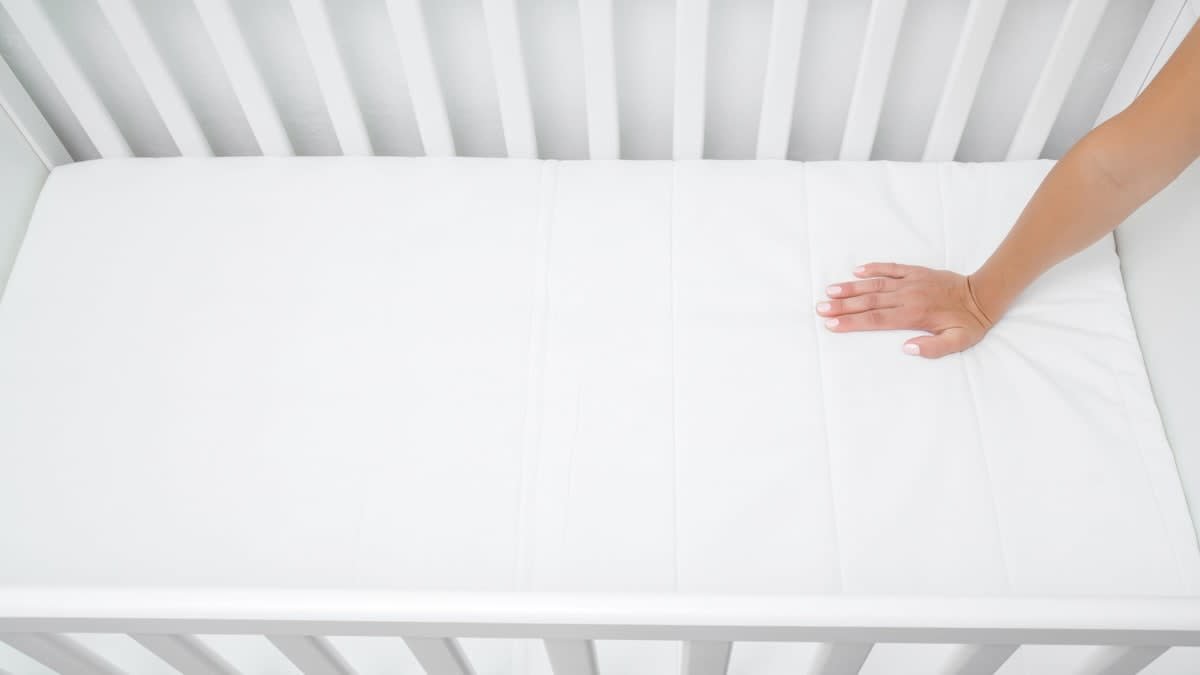
Preparing for a new baby involves setting up a crib and selecting a mattress. Fortunately, choosing a mattress is generally more straightforward than picking out the crib itself. While there are several factors to weigh—ranging from safety requirements to personal preferences—you can feel confident in your choice as long as you purchase a new mattress in the U.S., adhere to basic safety recommendations, and keep the sleep surface clean. Parenthood is demanding enough, so there is no need to add unnecessary stress to the process.
Below, you will find essential information regarding safety standards and concerns to keep in mind while shopping. You will also learn about mattress construction, pricing, and various features you might consider. Be sure to review our list of 12 top-rated crib mattresses, which have been evaluated for safety, sustainability, and material quality.
When organizing your baby’s sleep space before their arrival, follow the simple motto: “Bare is best.” This means keeping the crib as simple as possible by avoiding blankets, stuffed animals, bumpers, or any other items that could pose a risk if the baby rolls into them. Items like blankets and crib bumpers can lead to suffocation.
Safety is the top priority, and the Consumer Product Safety Commission (CPSC)—the agency that enforces safety standards for children’s products—has established guidelines to ensure all standard-sized crib mattresses sold in the U.S. meet specific thresholds. This includes sizing requirements: mattresses must be no more than 6 inches thick and at least 27¼ inches wide by 51¼ inches long. CPSC rules also state that when a mattress is sold with a crib, there should be no more than a ½-inch gap between the mattress edge and the crib perimeter.
Not all cribs follow standard sizing, such as oval or mini cribs. Naturally, the mattresses designed for these units are not standardized either. Instead, each nonstandard crib should be sold with a mattress that fits properly, ensuring there is no more than a ½-inch gap between the mattress and the crib frame.
Your baby’s mattress must be firm—likely much firmer than what an adult would find comfortable. In late 2022, the CPSC implemented updated safety standards requiring a specific firmness test, as soft sleep surfaces have been linked to infant deaths. You should ensure that your mattress was manufactured and sold in the U.S. after Aug. 15, 2022, in accordance with CPSC regulations.
A crib mattress should be firm enough that it does not compress under your baby’s weight. This also means avoiding memory foam, which is engineered to soften and contour to the body. Remember: keep the sleep environment simple.
You will quickly discover that babies can be quite messy. Leaking diapers and spit-up can leave a mattress damp or soiled, potentially fostering the growth of mold and mildew. It is wise to purchase a separate mattress cover to protect the sleep surface from microbes that could pose a health risk to your infant.
Babies should not sleep in your bed. The American Academy of Pediatrics (AAP) advises against any form of bed-sharing, including placing siblings in the same crib or sleeping with your baby in your own bed. Adult beds contain items like pillows and blankets that are unnecessary for a baby and can be dangerous. Soft bedding and loose objects increase the risk of strangulation and suffocation. If you happen to fall asleep with your baby in your bed, move them to their own crib as soon as you wake up.
There are two primary categories of crib mattresses: innerspring and foam. “Whether one is better than the other is really based on parent priorities,” says Carolynne Harvey, an infant and toddler sleep expert. “You can find good options in each category.” If you plan to reuse a mattress for a subsequent child, ensure it remains firm enough that it does not indent under the baby’s head or lose its shape when a fitted sheet is applied. If it shows signs of wear, it is time to replace it.
Foam mattresses are typically constructed from high-density polyurethane. Weighing between 8 and 13 pounds, they are generally lighter than innerspring models, making them easier to handle when changing sheets or adjusting the crib height. While they are often more affordable, with prices ranging from $40 to $400, they may also wear out faster. If the mattress begins to soften or compress under your baby’s weight, you should purchase a new one.
This type of foam is distinct from memory foam, also known as “viscoelastic foam,” which is designed to slowly conform to the shape of whatever is placed on it. Remember, you do not want your baby’s mattress to change shape when they are placed on it; the surface must remain firm.
Innerspring crib mattresses feature steel coils surrounded by foam or cotton cushioning. These typically range in price from $60 to $1,300 or more. They are heavier, usually weighing between 10 and 20 pounds, and are generally more durable than foam versions. “Innerspring mattresses still outsell foam crib mattresses as their construction usually leads to a longer life,” says Jenny Son, vice president and general merchandising manager at Buybuy Baby.
You can evaluate the quality and firmness of an innerspring mattress by its coil count. These steel springs provide the primary support for the mattress, with counts typically ranging from 80 to over 200 per mattress. A higher coil count generally indicates better support. This is crucial because infants require a very firm, supportive surface—it does not need to be a mattress that you would find comfortable.
Steel gauge is another metric used to determine firmness, referring to the thickness of the coils. A lower number indicates a thicker gauge, which results in a firmer mattress. Some higher-quality innerspring models also feature border rods, which are steel bars running along the edges to provide extra structural support.
Firmness and size are the most critical factors to consider when making your purchase. According to the AAP, the mattress should not indent when your baby lies on it, and it should fit snugly into the crib without any gaps.
Hybrid mattresses are two-sided options that can be used from infancy through the toddler years. Often referred to as dual-firm, two-stage, or convertible mattresses, they feature a firm side for infants and a slightly softer side for toddlers. However, the CPSC notes that both sides must be firm enough to be safe for a newborn, and these mattresses usually include instructions on when to flip them.
Because babies can be messy, a waterproof crib mattress cover is essential. Diaper blowouts, spit-up, and other spills can make a mattress unhygienic and dangerous. Since infants have developing immune systems that are susceptible to mold, bacteria, and other germs, keeping the mattress clean is vital. The best approach is to use a washable, waterproof cover. “I definitely recommend buying a separate waterproof cover,” Harvey says—and they’re safe.
The AAP suggests using a flannel-backed, waterproof mattress cover, as it is generally more comfortable and cooler for the baby. Ensure the cover fits the mattress perfectly so that the surface remains firm. While vinyl covers are effective and popular, you may want to look for a PVC-free option, according to James Dickerson, PhD, chief scientific officer and science adviser to the CEO at Consumer Reports. Vinyl may contain residual phthalates, which can be harmful to a baby’s development. The CPSC notes that phthalates can be particularly damaging to male reproductive development. “Look for products that say explicitly vinyl-free or phthalate-free,” Dickerson says. These covers are widely available and companies often highlight these features on their packaging.
“It’s possible to go the all-fabric route, too,” Dickerson says. “You’re just going to have a lot of thin layers, rather than one thick layer.” As long as you have a sufficient barrier between the baby and the mattress to prevent stains from reaching the core, you are in good shape.
Some manufacturers market “breathable” mattresses, claiming they promote safe sleep, prevent overheating, and reduce the risk of “rebreathing”—a theory that a baby inhaling their own carbon dioxide contributes to SIDS (sudden infant death syndrome).
However, the AAP states there is no evidence that rebreathing definitively causes SIDS, nor is there epidemiological data proving that “breathable” mattresses prevent it. That said, there is no harm in choosing one, provided it is firm and fits the crib correctly. You should still use a waterproof cover to prevent the buildup of mold, mildew, and other microbes that could harm your baby.
The Department of Agriculture regulates the “organic” label, and a product with this seal should contain at least 95 percent organic material. However, the CPSC does not regulate this term, so there are no specific guidelines for crib mattresses beyond general USDA regulations.
You can be confident that crib mattresses must meet specific safety standards, including limits on lead and phthalate content. If you are looking for additional safety certifications, you might look for the following:
Greenguard Gold sets limits on and tests for chemical emissions.
CertiPUR-US sets standards and tests for formaldehyde, heavy metals, and volatile organic compound emissions.
Global Organic Textile Standard (GOTS) label grade “organic” requires that at least 95 percent of a crib mattress’s materials are certified organic. It also prohibits certain compounds like phthalates and chemical flame retardants.
Global Organic Latex Standard (GOLS) guarantees that crib mattresses are made with 95 percent latex rubber sap content from rubber tree plantations that are certified organic.
First things first: Get that waterproof mattress cover! It’ll make cleanup so much easier. You can wipe the waterproof cover with a damp cloth or sponge and soapy water and let it dry before putting clean sheets back on. Don’t use harsh cleaning products or bleach, which might be bad for the waterproof layer.
Some mattress covers allow machine washing, then tumble drying on low. Wash it as needed—in other words, when your baby has any kind of accident. You can use whichever laundry detergent you typically like. But if your baby shows signs of skin allergies, or you simply feel like making the switch to something gentler, know that Consumer Reports gives Kirkland Signature Ultra Clean Free & Clear detergent a very good rating.
Ideally, your crib mattress cover is good enough that you won’t need to clean the mattress itself. If a stain happens to get through to the mattress, soak up any liquid with a dry rag, spot clean the mattress with soap and water, then let it dry before putting the mattress cover and sheets back on. Check the product instructions, though, for guidance on your specific crib mattress.
Babyletto is a baby and toddler gear brand owned by Million Dollar Baby, which also owns DaVinci, Namesake, and Ubabub. Babyletto specializes in mid- to high-priced infant sleep products. babyletto.com
Founded in 1955 by Sol and Anne Wolkin in Atlanta, the company is now run by second- and third-generation family members. Along with innerspring, natural and organic, portable crib, and custom mattresses, the company also manufactures changing table pads, rectangular and oval cradle pads, mattress covers, protectors, and comfort wedges. See website for a retailer near you. colgatekids.com
Family-owned and -operated since 1988, the company’s mattresses and bedding are made in the U.S., including the patented Convoluted Foam mattress, and the patented Innerspring Convoluted mattress. Other products include portable and full-sized cribs, strollers, toddler beds, bassinets, and other juvenile products. Available at most juvenile retailers. dreamonme.com
A division of Kastel International, Natural Mat’s mattresses are made in Devon, England, of natural, organic materials such as lambswool, natural latex foam, coir, mohair, and cotton. Organic top mats and bedding are also available on the company website. naturalmatusa.com
All Naturepedic natural and organic mattresses have been designed with the help of pediatricians, orthopedic specialists, chemists, and engineers. Research and design is coordinated by G.E.M. Testing & Engineering Labs in Cleveland. Also available are organic bassinet, cradle, and portable crib mattresses; organic twin, full, and queen mattresses; and organic changing pads, sheets, and pillows. naturpedic.com
Founded by Michael Rothbard in 2014, Newton Baby makes a wide range of midpriced baby gear, including cribs, mattresses, and crib linens. newtonbaby.com
Founded in 1992, this 100 percent organic company (which claims that even its facility is painted with zero-VOC paints) is based in San Diego. The company produces organic baby products such as clothing, bedding, diapers, and furniture—and even organic pet bedding. Go to the company website for purchasing information. purerest.com
In Sealy, Texas, in 1881, Daniel Haynes, cotton-gin builder, filled a request for a cotton-filled mattress. His business grew exponentially, which led to several patents—among them, a machine that compressed cotton. Its crib mattresses are sold under the name Kolcraft. sealy.comkolcraft.com

















One thought on “Best Crib Mattress Buying Guide”