
Garmin Forerunner 70 vs Forerunner 170 Comparison: 27 Feature Differences!

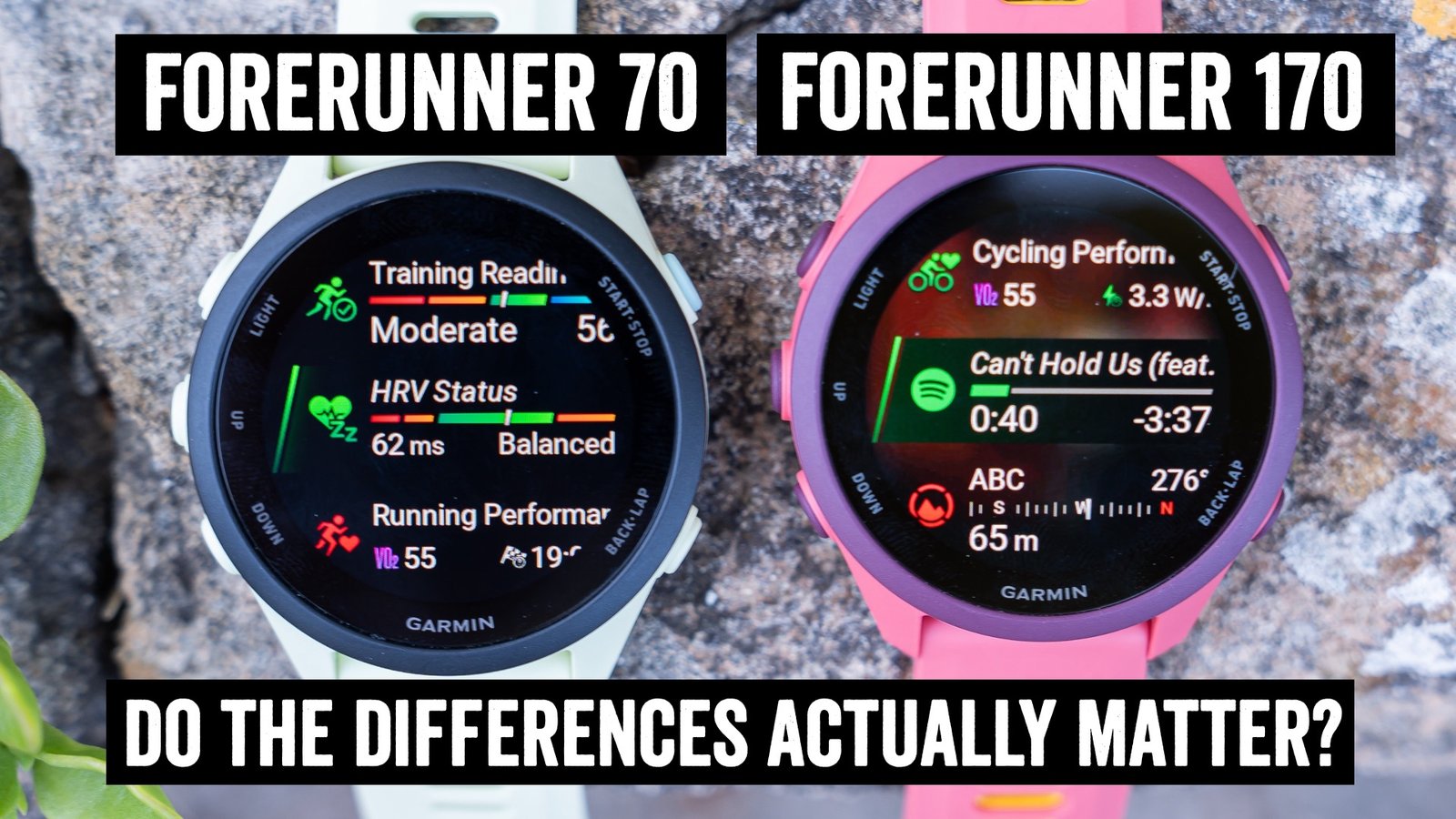
The Forerunner 70 and Forerunner 170 are perhaps two of the most similar watches Garmin has ever produced, though that is not necessarily a negative trait. The units carry a price difference of just $50, or $100 if you opt for the music-enabled version of the Forerunner 170. While they share many similarities, there are several key distinctions that may influence your decision depending on your priorities—specifically, the types of sports you plan to track.
These two devices are the most feature-rich and value-oriented watches Garmin has launched this decade. This represents a significant departure from the premium pricing seen across their 2025 lineup. Garmin is clearly aiming to undercut its budget-friendly competitors, and they are likely succeeding, particularly with the Forerunner 70.
I have been testing both watches side-by-side, wearing one on each wrist, to better understand how these differences manifest in real-world scenarios beyond the technical specifications.
With that, let’s dive into it!
The hardware on these two units is nearly identical, especially when viewed from the outside, where they appear indistinguishable. Only a few internal variations exist. Generally speaking, this is Garmin’s standard approach: reusing components across multiple product lines, with the majority of differentiation driven by software.
From any distance, they look identical, aside from the unique color options available for each model.
Still, here is how the two differ:
– The Forerunner 70 is $249, while the Forerunner 170 is $299, and the Forerunner 170 Music is $349.
– The Forerunner 70 comes in 6 colorways, while the Forerunner 170 offers 4 different colorways.
– The Forerunner 170 includes a music-capable edition, whereas the Forerunner 70 does not.
– The Forerunner 170 features Garmin Pay for contactless payments; the Forerunner 70 does not.
– The Forerunner 170 includes a barometer and altimeter, which the Forerunner 70 lacks.
– The Forerunner 170 contains a magnetic compass and gyroscope, neither of which is in the Forerunner 70.
– The Forerunner 170 features a temperature sensor integrated into the altimeter, which is absent in the Forerunner 70.
– The Forerunner 170 Music includes WiFi for syncing music, activities, and firmware updates, while the other models do not.
– The Forerunner 70 actually offers slightly longer battery life than the Forerunner 170, as it does not need to power the additional sensors like the barometer and altimeter, nor does it require the extra memory used by the music edition.
Here is a look at all the color options for the Forerunner 70:
And here are the color options for the Forerunner 170:
As mentioned, there are differences in battery performance. Here are the specifications for both variants:
Smartwatch mode: Up to 13 days (5 days always-on display)
Battery Saver Smartwatch mode: Up to 28 days
GPS Only GNSS Mode: Up to 23 hours
All-Systems GNSS Mode: Up to 16 hours
Smartwatch mode: Up to 10 days (4 days always-on display)
Battery Saver Smartwatch mode: Up to 19 days
GPS Only GNSS Mode: Up to 20 hours
All-Systems GNSS Mode: Up to 14 hours
Again, the higher power consumption of the Forerunner 170 compared to the more affordable Forerunner 70 is due to the fact that they use the same battery, but the 170 powers additional components like the gyroscope, altimeter, and barometer.
Beyond that, from a hardware perspective, they are otherwise identical:
– Both are 43mm watches with the same dimensions.
– Both feature 1.2″ touchscreen AMOLED displays.
– Both utilize Garmin’s standard 5-button configuration.
– Both are equipped with Garmin’s Elevate Gen4 optical heart rate sensor (Gen5 is the latest version, which includes ECG and skin temperature tracking).
– Both include PulseOx for blood oxygen monitoring.
– Neither supports ECG.
– Neither features multiband or dual-frequency GPS.
This is perhaps the closest I have seen two different tiers of watches released with nearly identical hardware. As is always the case with Garmin devices, however, the software creates even more separation.
The most important thing to understand regarding the software on the Forerunner 70 and 170 is that it utilizes the same underlying platform as many other watches launched in 2025, which debuted on the Fenix 8 in August 2024. This is Garmin’s new unified operating system, allowing for new features and bug fixes to be deployed universally across all devices. This has significantly improved the speed of updates, as a fix for the Fenix 8 Pro now applies to the Vivoactive 6, Forerunner 570/970, Venu 4, various Fenix models, and now the Forerunner 70/170.
More notably, from a feature perspective, this has led to many smaller capabilities trickling down from the Fenix series into entry-level watches, simply because it would have been more effort to remove them from the UI than to leave them in. Most of these are minor, such as the night-shift color options, the battery usage widget, or focus modes. In total, we are likely looking at hundreds of small features.
To that end, the Forerunner 70 and 170 are nearly identical in their actual functionality, save for a few features present on the 170 due to its extra hardware—such as music storage—and some expanded sports features on the Forerunner 170, which we will cover in the next section.
From a non-sports perspective, here are the differences:
The Forerunner 170’s Music Capability: The Forerunner 170 Music edition (but not the base Forerunner 170) can download music. This includes MP3 files as well as streaming services like Spotify, Amazon Music, and Deezer. As of this writing, the YouTube Music app is not yet available, though I expect that to change soon. This allows you to cache music offline and play it without a phone during workouts or at other times.
You must connect a pair of Bluetooth headphones or another audio device to the FR170 Music to hear the audio, as it lacks a full speaker and only has a beeper.
The Forerunner 170’s Contactless Payments (Garmin Pay): The FR170 includes Garmin Pay on all editions, allowing you to load a supported credit card from a participating bank onto your watch. As always, your bank must be on the Garmin Pay list, which is quite extensive depending on your region.
To use it, simply open the controls menu, tap the credit card icon, and enter your PIN. Afterward, you can tap the card reader just like you would with a physical contactless card or a smartphone.
Everything else remains the same, assuming we categorize altimeter, barometer, and compass data as sports-related information.
Most of the differences within the Forerunner 170 are found in the sports category, either linked to the altimeter, barometer, and compass functions or the additional power meter support. There are a few ancillary items, but those are the primary areas.
– The Forerunner 170 Music can generate voice prompts during a workoutadphones
– The Forerunner 170 includes the ABC (Altimeter, Barometer, Compass) widget, which the Forerunner 70 lacks due to its hardware configuration.
– The Forerunner 170 includes additional data fields for elevation, ascent, and descent.
– The Forerunner 170 features a temperature sensor and corresponding data fields.
– The Forerunner 170 includes the Storm Alert feature, which is triggered by the barometer.
– The Forerunner 170 offers “Cycling Performance” data and widgets, supporting power meters that the Forerunner 70 does not.
– The Forerunner 170 Cycling Performance widget estimates your cycling VO2Max (separate from running) and your current Functional Threshold Power (FTP).
– The Forerunner 170 can control an ANT+ FE-C smart trainer, including structured workouts.
– The Forerunner 170 includes a suite of additional cycling power meter data fields in bike profiles.
– The Forerunner 170 supports the Garmin Cycle Coach, as it is compatible with power meters.
Regarding sensor types, here is a quick list of supported devices:
– Forerunner 70/170 sensors: External HR (ANT+/Bluetooth), Footpod (ANT+/Bluetooth), Lights (ANT+), Cycling Radar (ANT+/Bluetooth), RD Pod (ANT+), Speed/Cadence Sensor (ANT+/Bluetooth), Tempe (ANT+/Bluetooth).
– The Forerunner 170 adds: Cycling Power (ANT+/Bluetooth), Smart Trainer (ANT+).
Here is the full list of sports modes, followed by the additional modes available on the FR170 variants:
Forerunner 70: Run, Track Run, Treadmill, Road Bike, Walk, Cardio, Strength, Pool Swim, Trail Run, Bike (Outdoor), Bike Indoor, Virtual Run, Indoor Track, Obstacle Racing, Ultra Run, MTB, eBike, eMTB, Cyclocross, Gravel Bike, Bike Commute, Bike Tour, Mobility, HIIT, Yoga, Pilates, Elliptical, Stair Stepper, Row Indoor, Walk Indoor, Boxing, Mixed Martial Arts, Jump Rope, Hike, Rucking, Mountaineering, Disc Golf, Horseback, Archery, Inline Skating, Ski, Snowboard, XC Classic Ski, XC Classic Skate, Snowshoe, Ice Skating, Snowmobile, SUP, Kayak, Row, Snorkel, Soccer/Football, American Football, Basketball, Baseball, Softball, Volleyball, Cricket, Lacrosse, Rugby, Field Hockey, Ice Hockey, Ultimate Disc, Tennis, Pickleball, Padel, Racquetball, Squash, Badminton, Table Tennis, Platform Tennis, ATV, Snowmobile, Overland, Motocross, Motorcycle, Horseback, Breathwork.
The Forerunner 170: Adds Floor Climb, Openwater (Swim).
The Forerunner 170 Music: Adds Guided Meditation.
The reason only the FR170 Music includes Guided Meditation is that it utilizes the audio playback capabilities through connected headphones.
Regarding the Forerunner 170 ABC features, the compass is useful in several ways. While navigating a course, it will instantly rotate the map page as you move, whereas the Forerunner 70 does not do this as quickly. Additionally, the FR170 allows you to lock a heading if desired.
You can also calibrate the altimeter and adjust the altimeter/barometer modes.
When it comes to elevation data, there are some interesting nuances. The Forerunner 70 does not display your current elevation during an activity, nor does it show ascent or descent values.
However, if you load a course or route, it will display ascent and descent data. You can see this on a hilly run from today:
(You can see total ascent, 104m, remaining ascent, 28m, current high/low altitudes, and a course profile. When I went off-route, I lost the remaining ascent metric.)
It is notable that you can go off-course and the watch will still track this correctly, as it is not strictly linked to the route file but rather uses GPS-based elevation data. This is confirmed at the end of the activity, where you will see the elevation graph and summary values. On this 5KM trail run, there was only a difference of a few meters despite some steep inclines and declines.
I suspect this difference is not meaningful for most users. Furthermore, once these files are uploaded to most platforms, the data is automatically corrected.
Regarding heart rate and GPS accuracy, I have observed no differences between the two units; they produce identical results. You can see this in my Forerunner 70 post, which includes data sets from both watches during the same activities.
For the single GPS sport mode not available on the Forerunner 70 (Openwater Swimming), I am seeing good results:
There is a minor difference between the multiband unit and the FR170, but that could easily be attributed to left versus right arm swing. I will perform another swim, switching arms at the halfway point, to see if there is any variance.
Critically for triathletes, neither watch includes a multisport or triathlon mode, which is notable because the Forerunner 265 and the Forerunner 570/970 do. This is essentially the only Forerunner 265 feature missing from the Forerunner 170. If you are not a triathlete and want to ensure you are on the latest software update path, I would choose the Forerunner 170 over the Forerunner 265. If you are a triathlete, you should avoid the Forerunner 170.
Ultimately, I believe the decision between the Forerunner 70 and the Forerunner 170 comes down to three key questions:
1) Do you care about Garmin Pay or Music?
2) Do you care about altimeter, barometer, and compass features, including improved trail navigation and elevation data during a run?
3) Do you care about cycling power meter support or openwater swimming?
If the answer to any of these is “yes,” the Forerunner 170 is likely the better choice. Alternatively, you might consider some of Garmin’s previous-generation watches on sale, such as the Forerunner 265, which is currently at a similar price point. As always with older Garmin models, you are weighing the lack of new feature updates against a solid deal. If you buy a Forerunner 265 knowing it will not receive new feature updates, you gain triathlon support and a few other benefits, though you will miss out on the new Quick Workout feature found on the 70/170.
You can spend all day comparing different Garmin watches, such as the FR265 at $349, the Epix Gen 2 at $399, or the Forerunner 965, as well as competitors like the COROS Pace 4 at $249, the Suunto Run or Race, or smartwatches like the Apple Watch SE at $249 or the Google Pixel Watch. But that is not the focus of this post.
Ultimately, I think the Forerunner 70 is the strongest value watch in Garmin’s current lineup, holding its own against many budget alternatives. The value proposition becomes more complex with the Forerunner 170 when compared to Garmin’s own previous-generation devices and those from competitors.
Thanks for reading!
Hopefully, you found this post useful. I am an athlete just like you, looking for as much detail as possible before making a purchase, so my review is written from the perspective of how I used the device. These reviews take many hours to compile. As you may have noticed, I also take the time to answer all questions posted in the comments, where there is a significant amount of additional detail.
If you are shopping for the Garmin Forerunner 70, the Garmin Forerunner 170, or any other accessories, please consider using the affiliate links below. As an Amazon Associate, I earn from qualifying purchases. It does not cost you anything extra, but your support helps this website significantly.
Finally, here is a list of accessories that work well with this unit. Given that the watch pairs with ANT+ and Bluetooth Smart sensors, you can use almost anything.
You can also sign up to be a DCR Supporter. That grants you an ad-free experience, access to the DCR Shed Talkin’ video series, and the knowledge that you are supporting the site. Thanks for reading, and feel free to post comments or questions below; I will do my best to answer them quickly. If you found this review useful, I always appreciate your feedback. Thanks!