
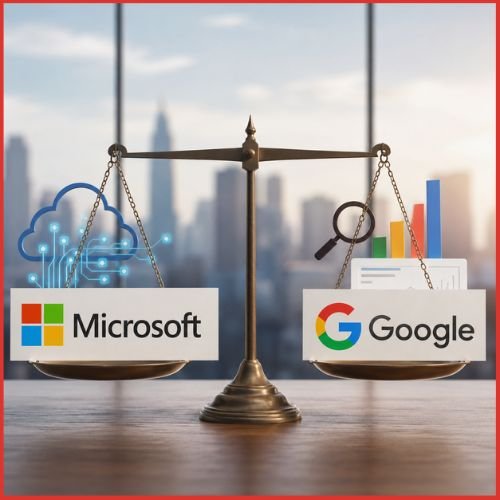
Microsoft vs. Google: Business Strategy and Revenue Comparison 2026
These two entities rank among the most valuable corporations globally. Neither relies on a single dominant product anymore; Microsoft moved beyond its identity as “the Windows company” over a decade ago, and Google evolved past being merely a search engine long before that. What remains are two distinct philosophies regarding how a tech giant should generate revenue—one rooted in subscriptions, contracts, and enterprise integration, and the other centered on attention, advertising, and massive scale.
Both are currently sprinting toward the same objective: leveraging artificial intelligence as the primary engine for future profitability.
However, they are approaching this goal from opposite directions, and that fundamental difference in their starting positions clarifies nearly everything about how each firm is managed, financed, and valued.
Two Business Models, Built on Opposite Assumptions
Microsoft’s strategy is built on predictability. By selling softwarethe company locks in a client’s infrastructure and expands the partnership over time. While it may lack glamour, it is exceptionally durable—the kind of revenue stream that does not vanish the moment a marketing budget is reduced
Google’s model is built on scale. By offering products like Search, Gmail, Android, and Maps for free, the company monetizes the massive amount of attention flowing through them. With billions of daily queries and ad impressions, this model scales almost infinitely, though it concentrates risk within a single category: advertising, specifically Search advertising.
Neither approach is objectively superior; they are simply different wagers on where value is captured. Microsoft bets on the enterprise relationship, while Google bets on the consumer moment. In 2026, both strategies are being tested simultaneously by the same force: artificial intelligence, which threatens to reshape how software is sold and how attention is monetized, sometimes simultaneously.
Revenue Breakdown: Where the Money Actually Comes From
Microsoft’s fiscal Q3 2026 revenue reached $82.9 billion, an 18% increase year-over-year. The Intelligent Cloud segment, which includes Azure, grew 30% to approximately $34.7 billion, with Azure itself rising 40%. Productivity and Business Processes, the division encompassing Microsoft 365 and LinkedIn, continues to expand at a steady mid-teens pace. Conversely, the More Personal Computing segment—covering legacy Windows and Xbox hardware—saw a slight decline. The narrative within Microsoft’s figures is clear: cloud and AI are driving the company forward, while the consumer hardware businesses that once defined the brand are now its smallest and slowest-growing components.
Alphabet’s Q2 2026 revenue hit $119.8 billion, a 24% year-over-year increase, outpacing Microsoft in both total volume and growth rate. Google Cloud posted 82% growth to $24.8 billion, an acceleration that surprised even analysts who had been closely tracking the segment. Search and other advertising generated $63.3 billion in that quarter alone, a single line item that exceeds the revenue of Microsoft’s entire Intelligent Cloud segment.
That represents the core asymmetry between these two giants. Google’s advertising engine is so vast that even its rapidly expanding Cloud business remains, for now, a secondary act.
The Cloud War Within the AI War
Cloud computing was already the primary point of friction between these two companies before generative AI emerged. Now, it serves as the battlefield where the AI race is being fought, billed, and won. Azure and Google Cloud are both growing at rates that would have seemed impossible five years ago—40% and 82% respectively in their most recent reports—but the drivers behind this growth differ significantly.
Azure’s expansion is largely driven by enterprise clients: existing Microsoft customers increasing their cloud footprint, adding Copilot seats, and consolidating infrastructure that previously ran on-premises. Google Cloud’s acceleration relies more heavily on new AI infrastructure demand, with companies renting computing power specifically to train or run their own AI models, alongside Google’s enterprise AI offerings. Both are effectively selling the same underlying resource—computing capacity—but Microsoft sells it through a two-decade-old enterprise relationship, whereas Google is selling it partly to a new generation of AI-native customers that did not exist as a buyer category before 2023.
Neither company can afford to lose this contest. Commercial remaining performance obligations—essentially contracted future revenue not yet recognized—reached roughly $627 billion for Microsoft and over $500 billion for Google Cloud’s backlog, with both figures climbing steeply each quarter. That represents hundreds of billions of dollars in future revenue already secured through contracts. Any failure to invest in data-center capacity now results in more than just a bad quarter; it means losing the ability to fulfill demand for years to come.
How Each Company Is Selling AI
Microsoft’s Approach: AI as a Subscription Add-On
Copilot is Microsoft’s solution, and it is marketed the way the company sells everything: as a premium layer atop software that users already purchase. Microsoft 365 Copilot surpassed 20 million paid enterprise seats in April 2026, up from 15 million just three months prior. This is not a free trial or a research demo; it is a per-seat, recurring, enterprise-billed product integrated directly into Word, Excel, Teams, and GitHub—tools that already serve as load-bearing infrastructure for most large corporations.
Google’s Approach: AI as the Product Experience Itself
Gemini took a different path. Rather than bolting AI onto an existing paid product, Google integrated it into the free experience that millions of people already use daily, primarily Search. The Gemini app alone reached nearly 950 million monthly active users, and Gemini models now process over 22 billion API tokens per minute. While that scale is staggering, the path to monetization is less direct than Microsoft’s per-seat model. Google is betting that AI-enhanced Search and a popular consumer app will eventually convert into deeper engagement, more subscriptions, and stronger advertising performance—a bet that is currently paying off, though it is structurally more difficult to track on a balance sheet than a Copilot seat count.
Profitability: Margins Tell a Different Story Than Growth
Growth headlines currently favor Google, but profitability headlines still favor Microsoft, though the gap is shrinking. Microsoft’s operating margin has historically hovered in the 45-47% range, reflecting decades spent optimizing enterprise software for maximum margin. Alphabet’s operating margin reached 34% in Q2 2026, expanding two percentage points as Cloud shifted from a money-losing growth bet into a genuine profit contributor; Cloud operating income roughly tripled year-over-year even as revenue grew 82%.
This shift is more significant than it appears. For years, analysts worried about Google Cloud’s heavy spending, thin margins, and uncertain path to profitability. That is no longer the case. If Cloud continues to convert revenue growth into operating income at this rate, Alphabet’s overall margin profile could feasibly close the gap with Microsoft within a few years rather than decades. Whether that happens depends almost entirely on capital expenditure discipline, and both companies are currently spending at a pace that would have been unthinkable prior to 2023.
Microsoft vs Google: Side-by-Side Comparison
Dimension: Microsoft | Google (Alphabet)
Core revenue engine: Enterprise software, licensing, and cloud infrastructure sold through subscriptions and long-term contracts. | Advertising, primarily Search, which still generates the majority of Alphabet’s total revenue despite Cloud’s rapid growth.
Cloud growth (FY26): Azure grew approximately 40% year-over-year in Q3 FY26, with Microsoft Cloud crossing a $200 billion annualized run rate. | Google Cloud grew 82% year-over-year in Q2 2026 to $24.8 billion, with backlog exceeding $500 billion.
AI monetization approach: Copilot embedded across Microsoft 365, GitHub, and Windows, sold largely as a per-seat subscription add-on. | Gemini embedded across Search, Workspace, and a standalone consumer app with nearly 950 million monthly active users.
Revenue diversity: Diversified across cloud, productivity software, gaming, and LinkedIn, reducing dependence on any single line. | Concentrated in advertising, though Cloud’s share of total revenue keeps climbing as it scales.
Profitability profile: High operating margins, historically around 45-47%, aided by enterprise contract stickiness. | Operating margin near 34% in Q2 2026, expanding as Cloud moves from loss-making to a meaningful profit contributor.
Primary competitive risk: Azure’s growth depends on continued enterprise AI adoption and data-center capacity keeping pace with demand. | Search faces the long-term question of whether AI-driven answers reduce ad-clickable traffic, even though near-term data shows no clear decline.
Microsoft’s enterprise relationships are deep and rarely churn quickly. Its Copilot monetization is direct, measurable, and already generating significant per-seat revenue rather than a vague promise of future engagement. Its margin profile remains superior, providing more room to absorb aggressive AI infrastructure spending without compressing profitability as sharply.
Google’s scale is nearly unmatched, with billions of daily touchpoints across Search, YouTube, and Android that have no direct equivalent at Microsoft. Cloud growth is currently outpacing Azure by a wide margin, and Search advertising—the business many assumed AI would cannibalize—has instead grown alongside AI Overviews rather than being replaced by them, based on the data available so far.
There is no clear winner here, and suggesting otherwise would be dishonest. Microsoft operates the more profitable and predictable business today, while Google operates the faster-growing, larger-scale business. Both are pouring extraordinary sums into the same underlying wager: that AI infrastructure demand will continue to compound for years, not just quarters. The real question is not which company is currently ahead, but which one built the more durable moat before the AI infrastructure buildout eventually slows. When growth normalizes—and it will—the company left with the better margins and the stickier customer relationships usually ends up holding the stronger hand.
Which company makes more money, Microsoft or Google?
Alphabet, Google’s parent company, currently generates more total revenue than Microsoft—$119.8 billion in Q2 2026 alone compared to Microsoft’s $82.9 billion in its most recent quarter—though Microsoft maintains higher operating margins.
Is Microsoft or Google more profitable?
Microsoft has historically posted higher operating margins, typically in the 45-47% range, compared to Alphabet’s roughly 34%, though Alphabet’s margin has been expanding as Google Cloud becomes more profitable.
Which company is winning the cloud computing race, Azure or Google Cloud?
How is Microsoft using AI to make money compared to Google?
Microsoft monetizes AI primarily through Copilot, a per-seat subscription add-on to existing enterprise software, while Google monetizes AI more indirectly through enhanced Search experiences and a large-scale consumer app, betting on engagement and advertising rather than direct subscription fees.
Will AI search hurt Google’s advertising business?
Data through mid-2026 shows no clear decline; Google Search advertising revenue grew 17% in Q2 2026 even after a full year of AI Overviews at global scale, though analysts continue to watch click-through rates to publishers and advertisers closely for longer-term signals.