
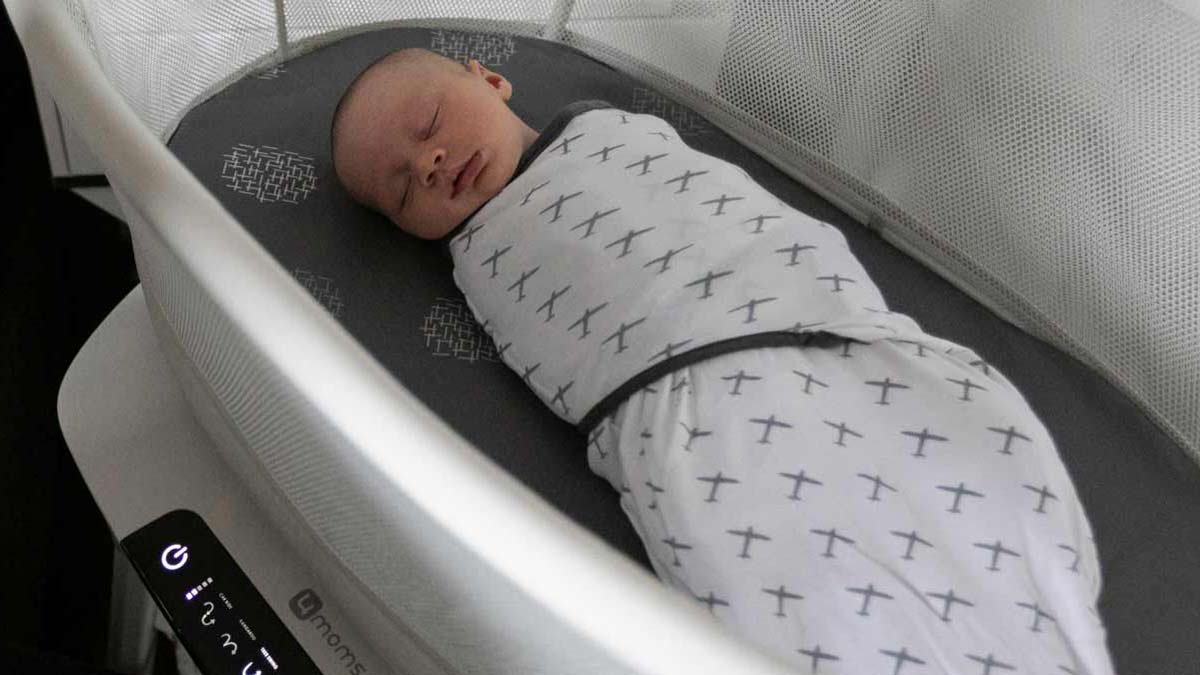
When you bring your newborn home from the hospital or birthing center, you will need a secure place for them to sleep. A bassinet is an excellent choice; because they are more compact than a standard crib, you can position one right beside your bed for convenient access. Depending on the specific design, you may also be able to move it between rooms. It is important to remember that bassinets are intended primarily for the newborn stage. Infants should only use them until they begin to roll over or push up on their hands and knees, or once they reach the manufacturer’s height or weight limits—whichever occurs first. After that, they should be moved to a crib or play yard for sleep.
You can rest assured that bassinets sold in the U.S. must comply with federal safety regulations. These standards mandate that bassinets and cradles include specific safety features. Among other requirements, the product must be sturdy enough to support the baby’s weight and stable enough to prevent tipping, even if a sibling leans against the side. For models that move, the design must ensure the rocking or swinging motion does not increase the risk of the baby becoming trapped against the side. Additionally, these products must adhere to strict safety limits regarding toxic chemicals like phthalates and lead.
Check our review of the best bassinets, which covers models from Halo, Maxi-Cosi, Snoo, and other brands.
Bassinets and cradles share similarities with cribs, but there are notable differences. Bassinets have a smaller footprint, which makes them easier to place next to your bed. The base might be stationary, or it may be designed to rock like a chair, or the sleeping area might swing back and forth. While bassinets are technically stationary and cradles are designed to rock, many brands now use these terms interchangeably. When the unit is not in motion, the sleep surface should be flat or at an incline of less than 10 degrees.
Most bassinets are smaller and lighter than a full-sized crib, making them generally easier to relocate. There are exceptions, however; smart bassinets like the Snoo and Cradlewise are heavier and not intended for travel or portability. Some models feature wheels to simplify moving them from room to room, which can be helpful if you want to keep an eye on your sleeping baby in different areas of the house. While some bassinets feature slight inclines, keep in mind that no infant sleep product should have an incline exceeding 10 degrees, and the American Academy of Pediatrics (AAP) notes that inclined surfaces do not help reduce infant reflux.
You can also find bassinets equipped with built-in hoods or canopies. It is vital that you do not drape blankets or other materials over a bassinet, as these items can fall onto the baby and pose a risk of smothering or strangulation. “Do not add an accessory to a sleep environment that is not specifically made and/or tested for safety with the item you intend to attach it to,” says Antoinette Burns, DO, associate medical director of the Sleep Lab at Children’s Hospital Colorado in Colorado Springs and associate professor at the University of Colorado School of Medicine.
A typical bassinet is rectangular or oval and compact enough to sit at your bedside, allowing you to reach your baby easily during the night. They should feature mesh or slatted sides that are lower than those of a crib, and some may unzip or fold down to make picking up your baby easier, which is particularly helpful if you have had a cesarean section. The sides must remain tall enough to prevent the baby from rolling out or to keep pets from jumping inside.
These electronic bassinets use vibration, rocking motions, and sounds to soothe your infant. Some smart models detect when a baby is fussy and respond automatically with soothing features, while others require a caregiver to activate the motions and sounds. A few smart bassinets even include lights meant to calm or entertain the baby. These units can often be controlledAmazon Alexa
If you intend to move the bassinet between rooms or take it to another house—such as when visiting grandparents—a travel or portable bassinet might be the right choice. The top models we tested can be disassembled or folded without tools, and their lightweight design makes them easy to stow or transport. Note that some portable bassinets are smaller than traditional versions, which may limit how long you can use them. It is also crucial never to place a portable bassinet on a soft or raised surface, such as a bed or countertop. “Babies have been injured in falls—and the soft surface may allow the bassinet to tip, putting the baby in an unsafe position,” says Nancy Cowles, child product safety expert and former executive director of the child product safety nonprofit Kids in Danger.
Bedside bassinets, often referred to as “co-sleepers,” are engineered to sit flush against your mattress for maximum accessibility. They usually attach directly to the adult bed, and the side facing the parent can often be lowered to make reaching the baby even simpler.
However, an “in-bed co-sleeper” is a different product; this is essentially an infant lounger placed directly on an adult’s bed. Consumer Reports has linked in-bed sleepers to infant deaths, and they are now prohibited under the Consumer Product Safety Commission’s Infant Safe Sleep Rule, which went into effect in 2022. The AAP advises against bed-sharing, as it is associated with sudden infant death syndrome (SIDS). “Not only do infant loungers or in-bed sleepers not make bed sharing safe, they add additional potential hazards to the sleep surface,” Cowles says.
Some experts suggest that bedside sleepers that attach to the frame of the bed can be a great option for some families. “There is no large-scale convincing data in regard to [bedside bassinets], but intuitively they seem safe, providing proximity and at the same time a separate surface,” says Eliot Katz, MD, medical director and division chief of the Sleep Center at Johns Hopkins All Children’s Hospital in St. Petersburg, Fla. “I think that it makes nighttime breastfeeding easier, and I personally have been recommending co-sleepers for years.”
Stroller bassinets are intended for the first few months of life, before a baby is ready to sit upright in a standard stroller seat. Once the child is older, you can replace the bassinet with a regular seat; these bassinets can also be detached and placed on a stationary stand for nighttime use.
“Strollers that come with bassinets must meet the safety standards for both strollers and bassinets,” Burns says. “A newer requirement for products with removable bassinets includes stability testing specifically for the bassinet once the bassinet is removed from the stroller.” If your product does not meet current safety standards—for example, if it is an older model or the manufacturing date is unknown—you should move the baby to a different sleep surface as soon as they fall asleep.
Cardboard bassinets, sometimes called “baby boxes,” are exactly what they sound like. Their popularity originated in Finland, where new parents have received a box of supplies since 1938 that can double as a sleeping space once emptied. While some have credited these boxes for Finland’s low SIDS rate, other experts point out that neighboring nations have achieved similar results without using them.
“Currently, there is not enough research and/or data to advise for or against any infant sleep product that is not already included in the published safety standards,” Burns says. “This includes any alternative sleep product, such as cardboard boxes, despite the popularity of alternative sleep products in some countries and cultures.”
Additionally, Red Nose Australia, an organization dedicated to infant safe sleep, advises against using cardboard bassinets because high humidity levels can compromise the structural integrity of the material.
Moses baskets are small, typically wicker containers that sit on a stand. “The American Academy of Pediatrics does not have an official statement about Moses baskets, but Moses baskets offer a firm sleep surface for infants that would meet the AAP recommendations about safe sleep environments for infants,” says Mary Beth Howard, MD, an emergency medicine physician at Johns Hopkins Children’s Center in Baltimore.
You should never carry a Moses basket while the baby is inside, nor should you place the basket on a table or counter; it must always be used with its designated stand. Moses baskets sold without a stand are in violation of bassinet safety standards.
All infant sleep products sold by established U.S. retailers are required to meet federal safety standards. Even so, there are several important safety considerations to keep in mind.
According to the American Academy of Pediatrics, the fundamental rules are:
Babies should sleep on their backs on a firm, flat mattress in their own sleep space.
For the first six months, infants should sleep in the same room as their parents, but never in the same bed.
Use only a fitted sheet; avoid bumpers, nursing pillows, blankets, or toys. Bumpers are specifically prohibited under the Safe Sleep for Babies Act.
The mattress must be firm enough that it does not compress under the baby’s weight, and it should be completely flat. Inclines of 10 degrees or more can obstruct a baby’s breathing.
The mattress must fit tightly against the sides of the bassinet to prevent the baby from becoming trapped in any gaps.
If your baby falls asleep in a swing, car seat, carrier, or stroller, move them to a firm, flat sleep surface on their back as soon as possible.
If you use the sound or white noise features on a bassinet, keep the volume at the lowest setting for a short duration, and if possible, place the baby’s head on the opposite side of the bassinet from the speaker.
“Bassinets are great for new babies, allowing them to sleep in the parents’ room and keeping them nearby throughout the house,” Cowles says. “But they can become unsafe if the baby uses it as they grow and develop. Signs of rolling over or pushing up on hands and knees mean it’s time to move baby to a crib. As with a crib, soft bedding or other items should not be put in the bassinet—nothing but baby.”
If possible, purchase a new bassinet or verify that the product meets current CPSC safety standards. Always check to ensure the model has not been subject to a recall. Avoid using a hand-me-down bassinet that is decades old; safety standards have improved significantly over time, and older products may have structural wear that makes them risky.
While a mobile is a cute addition, ensure it does not hang too low. Loose toys should be kept out of the bassinet, though the AAP notes that toys designed to clasp securely to the edge are generally acceptable, even if your baby is unlikely to show interest in them at first.
Although bassinets are more portable than cribs, you should never move them around the house while the baby is inside. “If you trip, the baby could be injured; they could fall out,” says Joan Muratore, who leads much of Consumer Reports’ baby product testing. “And suppose something failed or collapsed. You just don’t know what’s going to happen.”
Finally, remember that bassinets are a temporary solution. You will only be able to use them for a few months before needing a larger sleep environment. For your next step, you may want to consult our crib buying guide and our list of the year’s best cribs.
4moms creates high-tech baby gear, including bassinets, swings, and play yards. Known for innovative designs, its products are available at major retailers like Amazon, Target, and BuyBuy Baby.
BabyBjörn is a Swedish family-owned company founded in 1961, best known for ergonomic baby carriers, bouncers, and travel cribs. Its products emphasize simplicity, safety, and high-quality craftsmanship.
Baby Delight focuses on portable and lightweight baby products, including bassinets, loungers, and travel beds.
Boppy specializes in support products for pregnancy, newborns, and infants, particularly known for its nursing pillows, loungers, and pregnancy support pillows.
Chicco is part of the Artsana Group, an Italian company founded in 1958. It offers a wide range of baby gear, including strollers, car seats, bassinets, and high chairs, with a reputation for practical and parent-friendly design.
The Cradlewise AI-enabled smart bassinet is available online and through select baby gear retailers.
Founded more than 50 years ago, Delta Children’s products can be found at Amazon, Target, Walmart, and other retailers. It offers budget-friendly furniture, bassinets, cribs, and toddler beds.
Family-owned and operated since 1988, Dream on Me makes bassinets, cribs, gliders, and toddler beds, among other baby products, and contains brands Évolur, Sweetpea Baby, and Slumber Baby as part of its portfolio.
Owned by Dream On Me, Évolur offers nursery furniture including cribs, dressers, and gliders, available at large retailers like Amazon, Home Deport, and Sam’s Club.
A division of Mattel, Fisher-Price has been making toys and baby gear since 1930. It offers a wide range of wallet-friendly baby products, including bassinets, swings, and infant seats.
Graco is a budget-friendly baby gear brand that started to release baby products in 1955. It’s owned by Newell Brands, an American manufacturing company that also owns Rubbermaid, Sharpie, and Yankee Candle, among other brands.
Guava Family is known for its travel-friendly baby gear, including the Lotus Travel Crib and portable bassinets. Founded in 2008, its products emphasize lightweight, minimalist design.
Halo is best known for its sleep products, including the Halo BassiNest Swivel Sleeper and wearable sleep sacks.
Founded by pediatrician Harvey Karp, MD, Happiest Baby makes the Snoo Smart Sleeper bassinet, available for sale or rent, as well as other sleep and soothing products for infants.
Ingenuity Baby is a subsidiary of Kids II, which was founded in 1969 and also owns Baby Einstein, Summer Infant, and Bright Starts. Ingenuity baby gear is available at major retailers such as Amazon, Target, Walmart, and Wayfair.
Maxi-Cosi is a high-end line of baby gear that offers car seats, strollers, and bassinets. Parent company Dorel Juvenile also owns Safety 1st, Tiny Love, Cosco Kids, and other child-product brands.
Founded in 2014, Newton Baby makes a wide range of midpriced nursery and sleep-focused baby gear, including cribs, mattresses, and bassinets, with a focus on breathability and sustainability.
Pottery Barn Kids (part of the Williams Sonoma company) sells cribs, bassinets, and other baby furniture. Its products can be purchased both in-store and online.
Ronbei makes bassinets, play pens, safety gates, and other baby gear available at Amazon and Walmart.
Owned by Dorel Juvenile, Safety 1st is a cost-conscious line of baby gear products, including car seats, bassinets, and strollers.
Now owned by Delta Children, Simmons Kids is a child-focused line of baby sleep gear from mattress maker Simmons, offering cribs, mattresses, and nursery furniture.
Owned by parent company RBO, which also runs Little Partners, Rack Furniture, and Busy Kids, TruBliss makes a line of traditional and smart bassinets.