


Battery-powered tools offer significant advantages. Unlike their gasoline-fueled counterparts, they provide instant starting, require less maintenance, and generally operate with less noise and weight. Furthermore, they are much more environmentally friendly than gas-powered options, <a href="https://shoppixy.com/which-menopause-supplement-is-best/” title=”Which menopause supplement is best?”>which is a major benefit in our view.
Simply put, many of these tools are now exceptionally high-performing. Manufacturers have invested heavily in refining this equipment and the lithium-ion batteries that drive them, with impressive results. In several lawn care categories evaluated by our testing, battery-powered tools now match or even exceed the performance of gas models. For leaf blowers, chainsaws, and lawn mowers, the top battery-powered options in our ratings hold a distinct advantage over gas versions.
However, battery tools carry a higher price tag, often costing more upfront than comparable gas-powered equipment. Depending on the manufacturer, a single battery can cost anywhere from $50 to over $300. When you add the price of the tool itself, the investment grows. While you can typically purchase tools bundled with a battery and charger, buying multiple items this way from the same brand often leads to paying for redundant chargers and batteries you may not actually need.
This is where the concept of a battery platform becomes essential.
Tool manufacturers are now designing battery-operated equipment as part of a unified family. In some cases, these families are quite extensive. For instance, Milwaukee notes that its 18-volt brushless battery chainsaw belongs to a system encompassing over 250 different tools. Similarly, Makita offers a system that includes 350 pieces of equipment.
A battery platform is essentially a line of tools from a single brand that utilizes a specific battery or set of batteries of a matching voltage. These batteries are designed to be interchangeable across the entire range. Using one type of charger for all your tools also simplifies your setup significantly.
If you own several yard tools from one platform, the goal is to power your string trimmer, leaf blower, and lawn mower using the same battery. While some equipment, such as a lawn mower, might require multiple batteries, a string trimmer typically only needs one. If your battery runs low while you are working, you can simply swap it for a fresh one that has been charging.
It is important to remember that tools must be compatible with the same battery and voltage, and that batteries are proprietary to specific brands and sometimes even specific systems within a brand. A 60-volt Greenworks battery will work with any Greenworks tool requiring that voltage, but it will not power an 80-volt Greenworks mower, nor will it work with a 60-volt DeWalt mower.
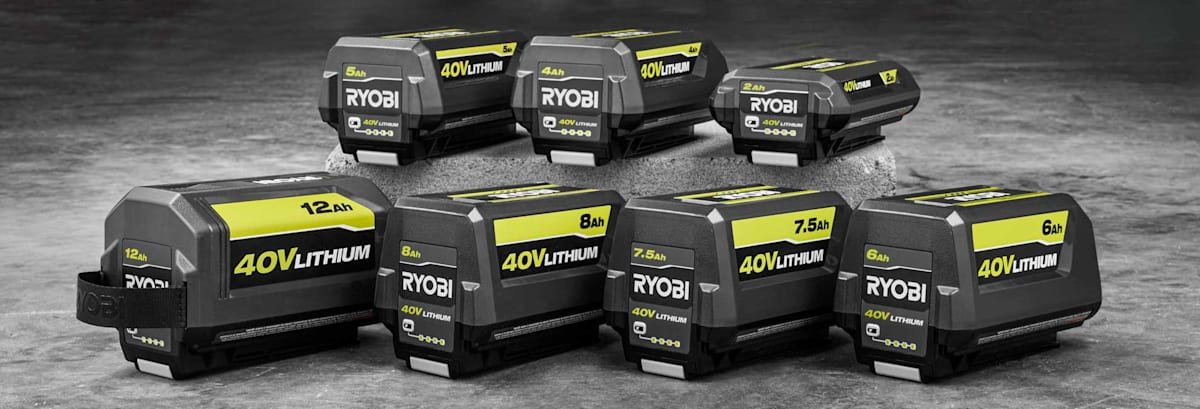
Committing to a single battery platform can provide both convenience and long-term savings. Once you own a tool that includes a battery, you can often purchase “bare” tools from the same platform later at a lower cost. For example, if you buy a 40-volt Ryobi chainsaw this spring that includes two batteries and a charger, you can purchase a leaf blower by itself in the fall and save approximately 25 percent.
As a starting point, consider which tools you need and how frequently you plan to use them. Think about the scale of your projects and the duration of continuous use required. Do you have a small lawn to maintain? Are you planning to build a deck or undertake a major renovation? How often will you use a chainsaw compared to a leaf blower? Once you have answered these questions, you will be better prepared to select the right tools for your needs.
We recommend consulting our ratings of battery power tools by brand. These ratings provide an Overall Score for each platform, along with details on individual products. Here are several factors to keep in mind when shopping for a platform and reviewing our ratings.
Tool performance: Examine the range of tools within a brand’s platform to ensure it includes everything you need. You can then use our ratings to gauge the performance of individual items. If a brand’s platform earns high marks for its lawn mower, chainsaw, and leaf blower but lacks a hedge trimmer you require, you might want to look at a different platform that offers a complete set.
Weight: Consider the weight of the tool and how it feels during operation. Our individual product pages for handheld tools include specific weight information.
Cost: Your choice of platform will be influenced by your budget. Keep in mind that the cost of a single battery can range from about $50 to more than $300, and that is before accounting for the price of the tool itself.
Pay close attention to the battery’s voltage and capacity. The platforms in our ratings range from 18 volts to 80 volts. If you are purchasing multiple tools within one platform, they must all use the same battery voltage. Generally, tasks that require more power demand a higher voltage.
While the voltage must be uniform for all tools in a platform, the battery capacity can vary. Capacity is measured in amp-hours and indicates how long a battery will run before it needs to be recharged. For example, an Ego 56-volt lawn mower might come with a 6-amp-hour battery, while the company’s 56-volt string trimmer might include a smaller 4-amp-hour battery.
Keep in mind that higher capacity usually means a larger, heavier battery. While you could technically use the mower’s battery in your string trimmer, the added weight might make the tool uncomfortable to carry for extended periods.
One final warning: avoid knockoff batteries. You can only be certain that a lithium-ion battery is safe and tested for your specific tools if it is produced by the original manufacturer. Counterfeit batteries can pose a danger to you and cause damage to your equipment. The Power Tool Institute warns that using a battery not specifically designed for a tool or charger can lead to various issues, including equipment failure or even fire.
Our testing teams evaluate battery power tools at our facility in Yonkers, N.Y., as well as in Florida, where grass grows year-round. We do not accept products from manufacturers for testing. Instead, we purchase all equipment at retail stores, just as any consumer would.
To determine our battery platform ratings, we aggregated data from our individual product tests and calculated the average scores of a brand’s highest-performing tools within that platform. We included the best-performing string trimmers, leaf blowers, chainsaws, hedge trimmers, lawn mowers, drills, and impact drivers. While not every brand offered all these products, we only included platforms that featured at least three of them.
In our individual product tests, we measure performance, ease of handling, and noise levels. We also compare battery-powered yard tools against gas models to see if they can deliver comparable power. Here are more details on how we test the tools that contribute to our platform ratings.
For string trimmers, we evaluate how evenly a model cuts through tall grass, weeds, and dense brush. We also test its effectiveness at edging along walkways. We assess how easy each trimmer is to maneuver and operate, noting any difficulties in starting the tool or feeding line through the cutting head.
For leaf blowers, we time how long it takes each model to clear a large pile of leaves and evaluate how well it dislodges debris embedded in grass.
For chainsaws, we time how long it takes to cut through a 10-inch-thick oak beam. We evaluate the quality of the cut and track how many cuts the saw can complete on a single charge, while also noting important safety features.
For hedge trimmers, we test cutting capacity, handling, and safety. We use large patches of invasive bamboo at our New York campus to test these tools, starting with thin growth and moving up to thicker shoots to see how cleanly and quickly each tool performs.
For lawn mowers, our engineers test new models on specially prepared lawns in Florida during the late winter. We operate the mowers in various modes—such as mulching, bagging, and side discharge—to see how well they handle each task and how evenly they cut.
For drills, we use a device called a dynamometer to measure torque under different loads, which allows us to score them on power, speed, and run time.
For impact drivers, we use dynamometers to measure both the torque generated and the number of impacts per minute. To assess run time, we measure how long a battery can power the unit under a standardized load, and we also time how long it takes to fully charge the battery.
For snow blowers, we use a mixture of water-saturated sawdust to ensure test consistency. This mixture can simulate a standard snowfall or be molded into a pile similar to what a plow truck leaves at the end of a driveway. We time how quickly each blower clears this dense material and note how far the debris is thrown and how clean the surface remains. We do not include snow blowers in our battery platform ratings, though we note if a brand has one we have tested.
For pressure washers, we measure the pounds per square inch of pressure produced and time how long it takes to strip paint from plastic panels. We also assess noise levels and ease of use. We do not include pressure washers in our battery platform ratings, though we note if a brand has one we have tested.
The Cat 18-volt battery platform supports a drill, an impact driver, and a lawn mower. Its 60-volt platform includes a lawn mower, leaf blower, and chainsaw. Cat tools are available at retailers such as Home Depot and Lowe’s.
Ego produces a 56-volt lithium-ion battery that powers all tools in its platform, including a lawn mower, string trimmer, leaf blower, chainsaw, and hedge trimmer. This same battery also powers equipment like snow blowers, snow shovels, misting fans, and a mini bike. Ego products are sold at Lowe’s and Ace Hardware.
Greenworks offers both 60-volt and 80-volt battery platforms. The 60-volt system includes a lawn mower, string trimmer, leaf blower, and hedge trimmer. The 80-volt system features a lawn mower, string trimmer, leaf blower, and chainsaw. Greenworks tools can be purchased at Walmart, Amazon, Lowe’s, and other retailers.
Husqvarna’s battery-powered lineup includes a lawn mower, string trimmer, leaf blower, and chainsaw, among other tools. Husqvarna products are available at Lowe’s.
The Kobalt 80-volt battery platform includes a lawn mower, string trimmer, and chainsaw. Kobalt also produces yard tools on a 24-volt platform, which features a lawn mower, string trimmer, leaf blower, chainsaw, and hedge trimmer. Kobalt tools are sold at Lowe’s.
Makita offers both 18-volt and 40-volt battery platforms. The 18-volt system includes a lawn mower, string trimmer, leaf blower, drill, and impact driver. The 40-volt system includes a lawn mower, string trimmer, leaf blower, chainsaw, and drill. Makita tools are available at Tractor Supply, Home Depot, and other stores.
The Milwaukee 18-volt battery platform supports yard tools such as a lawn mower, string trimmer, leaf blower, chainsaw, and hedge trimmer. The platform also includes an impact driver and a drill. Milwaukee tools can be purchased at Home Depot, Acme Tools, Ace Hardware, and various other retailers.
Ryobi provides tools and equipment powered by 18-volt, 40-volt, and 80-volt batteries. Its 18-volt system includes a lawn mower, string trimmer, leaf blower, hedge trimmer, drill, and impact driver. The 40-volt system includes a lawn mower, string trimmer, leaf blower, chainsaw, and hedge trimmer. The 80-volt system features a self-propelled mower and riding mowers. Ryobi tools are sold at Home Depot.
Worx manufactures tools that operate on 20-volt, 40-volt, or 80-volt batteries. Because these tools all utilize a single “power share” battery, they are considered part of one unified platform. Tools in this platform include a lawn mower, string trimmer, and leaf blower, among others. Worx tools are available at Tractor Supply, Lowe’s, and Amazon.


















2 thoughts on “Battery Platform Buying Guide”