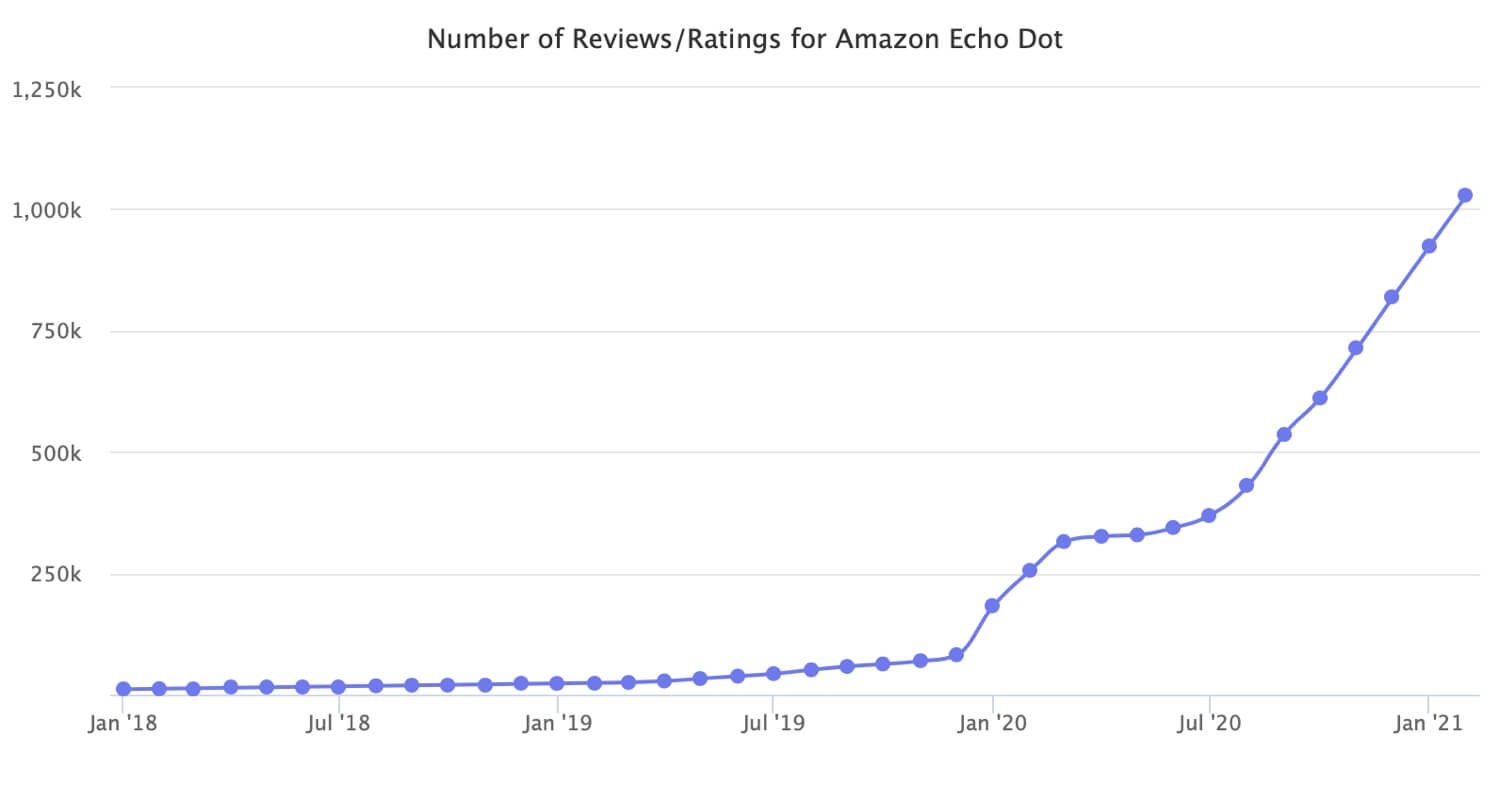
The Amazon Echo Dot smart speaker has become the first product on the platform to accumulate over one million reviews. The volume of feedback for popular items on Amazon has surged, shifting their perceived value following the company’s introduction of one-tap ratings in late 2019.
In October 2019, Amazon expanded its review system by allowing customers to submit a star rating without providing a written comment. Since that change, the speed at which products collect feedback has accelerated. The Amazon Echo Dot now gains more than 100,000 new ratings every month—a milestone it took more than three years to reach following its initial launch.
It is now significantly easier for products to accumulate feedback, yet it has become harder for new items to compete against established products that already boast tens of thousands of reviews. Since the implementation of one-tap ratings, the competitive landscape for products has fundamentally changed.
In the letter announcing his departure as CEO, Jeff Bezos wrote that one of Amazon’s key innovations was “pioneering customer reviews.” Some have argued that Amazon aimed to replace brand trust with these customer reviews. However, while reviews were once a reliable resource for shoppers, their influence grew alongside the size of the platform. Consequently, generating fake reviews became a worthwhile endeavor, and the notion that reviews could serve as a substitute for brand reputation ultimately failed.
Customer reviews are inherently biased and easily manipulated, regardless of how diligently Amazon attempts to filter out fraudulent entries. Instead, it appears Amazon has opted to address the issue through sheer volume. Rather than products having hundreds of thousands of ratings—some of which may be untrustworthy—items now have an order of magnitude more feedback. The signal to the consumer is simply that a large number of people purchased the item and that it remains available on Amazon.
Customer reviews are no longer primarily about reading individual entries to identify reasons to avoid a purchase. Instead, they serve as a signal, with shoppers using the presence of hundreds of thousands of ratings as a shorthand for quality. The Amazon Echo Dot has 5,000 written 1-star reviews and an additional 10,000 1-star ratings without written comments. Even if a shopper wanted to examine the negative feedback, they would only be seeing a fraction of the total complaints.
All of this is to say that if customer reviews were an innovation that truly worked, there would not be a need for products to have millions of ratings to drown out the noise.
It remains unclear whether shoppers distinguish between a product with ten, a thousand, or a hundred thousand ratings. If brands were the primary shortcut on traditional retail shelves, and reviews were intended to replace that on Amazon, the current shortcut is simply being among the first few search results. In this context, reviews and ratings act as visual filler, confirming that at least one other Amazon customer has purchased the item.





















2 thoughts on “First Product on Amazon With One Million Reviews”